A Politics of Disinhibition
I am serializing a new book,Why We Need an Esoteric Left, as I write it. We are currently in Chapter Four, “Our Civilizational Psychosis,” which includes two parts: First, the outer history of how the. . .
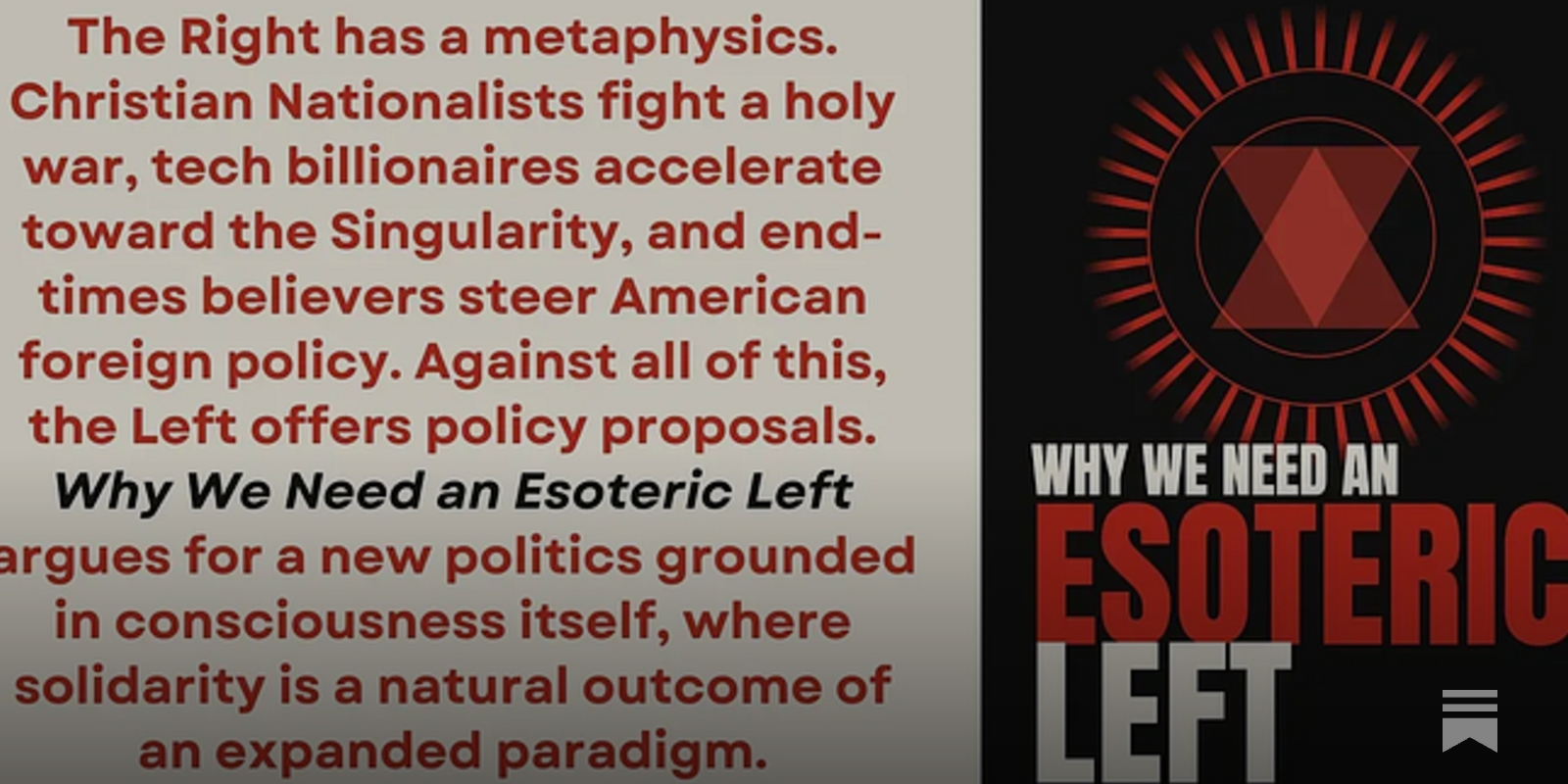
I am serializing a new book,Why We Need an Esoteric Left, as I write it. We are currently in Chapter Four, “Our Civilizational Psychosis,” which includes two parts: First, the outer history of how the American Left was tactically destroyed while the counterculture was absorbed, Second, the inner history, looking at the deeper metaphysical wound the Left inflicted on itself, and how to heal it so we can move forward in unity and solidarity. Before I explore what kind of new paradigm or “transformation of values” might support a revitalized alternative, I felt the need to add another layer to my analysis about where we find ourselves now. Last time, I explored how the radical counterculture of the 1960s — which seemed, for a brief period, capable of instigating an actual insurrection — ended up absorbed into lifestyle marketing and identity politics that failed to address the structural basis of oppression. The Right eventually learned to imitate and co-opt the forms of countercultural rebellion (for instance with comedians like Joe Rogan and Theo Von), as the Left became more sanctimonious and controlling. In the 1960s, the Left represented the exciting edge of transgression, the rejection of censorship, and the breaking free from ossified norms and structures. That changed over the last decades. As counterculture values were haphazardly institutionalized, a rebellion against them seemed vitalizing to many. (For instance the “trad wife” as an answer to an incomplete sexual revolution; racism as an answer to multicultural pluralism; Christianity as an answer to secular atheism). This flip intensified the general ambience of confusion and mistrust. As a cultural sea-change, it opened a window for reactionary populism. We can now better understand and analyze how this reactionary movement operates: What’s fascinating is its paradoxical, apparently nonsensical, combination of highly complex technocratic instruments with a rejection and repudiation of science and reason as meaningful or even real. The authoritarian takeover in the U. S. combines high-tech algorithmic administration with mythic, grievance-driven populism (QAnon, etcetera) to manage a populace increasingly pushed to the margins by digital automation, precarity, depletion of resources, and environmental collapse. As platform monopolies hollow out middle-class prosperity and corporate elites lose their dependency on human labor (via AI and automation), they seek to weaponize instrumental reason through technologies of control and psychological manipulation while exploiting social media to deepen ancient cultural tribalism by spreading mass deceptions. To break this loop, a humane alternative cannot merely defend an obsolete technocratic status quo: We must reclaim a deeper form of reason that not only restores material solidarity and genuine human agency but reclaims the sacred, holy, and transcendent from those who manipulate faith and fealty for authoritarian aims. If this seems opaque at all, I hope it becomes clear in what follows. Please let me know what you think in the comments!The apparent contradiction of our moment—extreme technological sophistication combined with climate denial, conspiracism, religious nationalism, and attacks on scientific and democratic institutions—is not accidental. It reveals something fundamental about the new political order. One provisional thesis sees the present authoritarian turn as the political form taken by late-stage capitalism as it loses its capacity to generate broad levels of prosperity, democratic legitimacy, material improvement, and a secure future. Digital technologies enable unprecedented concentration of wealth, information, and power, while ecological crisis and economic stagnation undermine the old liberal promise of continual progress. The resulting regime combines instrumental hyper-rationality at the level of administration with mythic politics at the level of mass consciousness. Rather than a regression or rejection of modernity, we are witnessing a new synthesis: algorithmic administration above, mythic identification below. Yanis Varoufakis’s idea of “technofeudalism” captures one dimension of this transformation. Whether or not one supports his term, the central insight is compelling. The dominant technology companies no longer merely compete in markets. They increasingly own the infrastructures within which markets, communication, and even social life take place. They function simultaneously as landlords, regulators, surveillance systems, and marketplaces. Power has moved from competitive capitalism to ownership of the digital platforms and networks themselves (hence Elon Musk’s purchase of Twitter, the Ellisons’ takeover of Paramount and of TikTok’s U. S. operations via an Oracle-led consortium, and their bid for Warner Bros. , currently paused by a federal judge). This profoundly alters the relationship between economic elites and democracy. Industrial capitalism required large workforces, rising wages, public education, and mass consumption. Digital capitalism increasingly depends on intellectual property, automation, data, AI, financial assets, and network effects. As AI and robotics advance, the bargaining power of labor is likely to decline further, or to crash to zero. When ordinary people are no longer crucial for the functioning of the economy while they retain democratic claims on prosperity and political influence, elites become increasingly incentivized to weaken or disrupt democracy itself. Authoritarianism — or autocracy — becomes a way of preserving concentrated ownership while managing, and controlling, increasingly precarious and angry populations. At the same time, the neoliberal agreement has exhausted its legitimacy. For forty years, societies were told that globalization, deregulation, privatization, and financialization would benefit everyone. Instead, many have experienced stagnant wages, declining quality of life, dysfunctional public institutions, growing levels of inequality, and loss of status. As this promise collapses, the fulcrum of political discourse shifts away from competing economic programs toward struggles over identity, belonging, resentment, and national destiny. Material grievances become translated into cultural conflict. Economic insecurity can be directed to amplify anger toward immigrants, intellectuals, minorities, universities, or imagined conspiracies, hiding the structural forces causing mass precarity. The authoritarian leader offers a psychologically satisfying explanation for diffuse social suffering. Instead of dealing with the structural contradictions of late-stage capitalism, he points at visible enemies and the promise of national restoration. Much of what we are now experiencing — in a new, intensified form — was already well understood and analyzed by Frankfurt School philosophers such as Max Horkheimer and Theodor Adorno. Their book Dialectic of Enlightenment proposed that the project of Enlightenment—which aimed to free humanity from myth, superstition, and domination through science and reason—has, under modern capitalism and technological society, turned into a new form of domination. Rationality, instead of liberating people, increasingly becomes an instrument for controlling both nature and human beings. Reason gradually narrowed into what they call “instrumental reason”: Thinking focused primarily on efficiency, calculation, prediction, and control. Rather than asking, ‘What is good?’ or ‘What is true?’, instrumental reason asks, ‘What works for my defined goal?’ or ‘How can this be managed?’ This constrained approach to reason gives science, bureaucracy, markets, and technology immense power while leaving deeper ethical questions unanswered and subordinating objective evidence to goal-oriented operations. Adorno and Horkheimer did not believe that this form of rationality eliminates myth. Instead, they argued that Enlightenment itself establishes a new mythic mode: When reason is reduced to calculation, efficiency, and control — to instrumental reason — it eventually loses the capacity to reflect upon its own purposes. In fact, Frankfurt School philosophers continued to nurture the hope that reason would provide an antidote to the excesses of a hyper-rationalist and technocratic order. Herbert Marcuse noted in Reason and Revolution: “Reason, and Reason alone, contains its own corrective. ”As we see today, the contemporary authoritarian state does not reject reason altogether. Instead, it divides reason into two separate domains. Within systems of administration, it embraces scientific and technical rationality enthusiastically: artificial intelligence, surveillance, logistics, financial engineering, predictive analytics, military technology, and behavioral science. Within the public sphere, however, it undermines the authority of science whenever scientific knowledge creates political or social obligations. Climate science gets reframed as a politicized mass deception. Public health expertise becomes ideological. Universities that support freedom of inquiry are turned into enemies. Journalism becomes propaganda. This distinction is perfectly coherent from the standpoint of power. Science as an instrument of control is welcomed. Science as an independent source of public truth becomes dangerous, and something to suppress. Climate denial illustrates this particularly well. Climate science does not merely describe atmospheric patterns and future trends. It inevitably reveals that existing modes of industrial production, extraction, consumption, and ownership cannot continue indefinitely. Therefore, it threatens powerful economic interests, albeit short-term ones. Denial becomes less a rejection of evidence than a defense of an entire social order built upon foundational lies. Meanwhile, the mythic dimension of politics has also changed. Twentieth-century fascism relied upon centralized propaganda, state media, and mass rallies. Today’s mythic symbols and narratives are generated via algorithmic tools and mass-distributed instantly (QAnon as an example). Social media platforms continuously reveal which stories best maximize outrage, fear, resentment, and tribal identification. The myths themselves often appear ancient—national rebirth, sacred identity, violent migrants, heroic warriors, secret enemies—but their mass production and distribution is a contemporary phenomenon. With this new form of algorithmic myth-making, ancient archetypes and virulent memes get optimized through real-time computational feedback. The new instantaneous mythic style feeds into the phenomenon that theorist Anton Jäger calls “hyperpolitics. ” In his recent book Hyperpolitics: Extreme Politicization without Political Consequences, he looks at how today’s social movements and activist protests (whether from the Left or Right) function as short-lived digital “swarms” rather than disciplined, membership-based organizations able to build or wield long-term power. Jäger compares today’s “hyperpolitics” to the Cheshire Cat’s grin—intense bursts of political expression without an organizational “body” to bring about sustained results. He summarizes it as, all too often, “low-commitment, low-cost, and low-value” political engagement, supported by the instantaneity of social media. Psychologically, authoritarianism also acts as a politics of disinhibition. Contemporary neoliberal culture forced people to constrain their antisocial impulses — to become entrepreneurs of themselves, constantly “on show” via social media. The policing of language and sexual expression by the identity-focused “victim politics” of the Left added to this subjective feeling of constraint. Knowledge workers and influencers, in particular, have to optimize themselves continuously, compete constantly, while struggling with precarity. They are entrained to blame their failures on personal inadequacy. As the philosopher Byung-Chul Han wrote inPsychopolitics: “Today, everyone is an auto-exploiting labourer in his or her own enterprise. ”When even this promise collapses, frustration seeks another outlet. The authoritarian leader appears liberated from the restraints imposed upon everyone else. He insults opponents, violates norms, ignores facts, and suffers zero consequences. His cult followers experience this as a symbolic liberation.