Analilia Mejía’s Historic Congressional Win Was No Surprise to the Authors of Politics in Our Veins - NYU Press
by Yalidy Matos, Domingo Morel and Michelle Bueno Vásquez Politics has always been in our veins On April 16, 2026, Analilia Mejía won New Jersey’s 11th Congressional District special election by 41 points, becoming. . . READ MORE
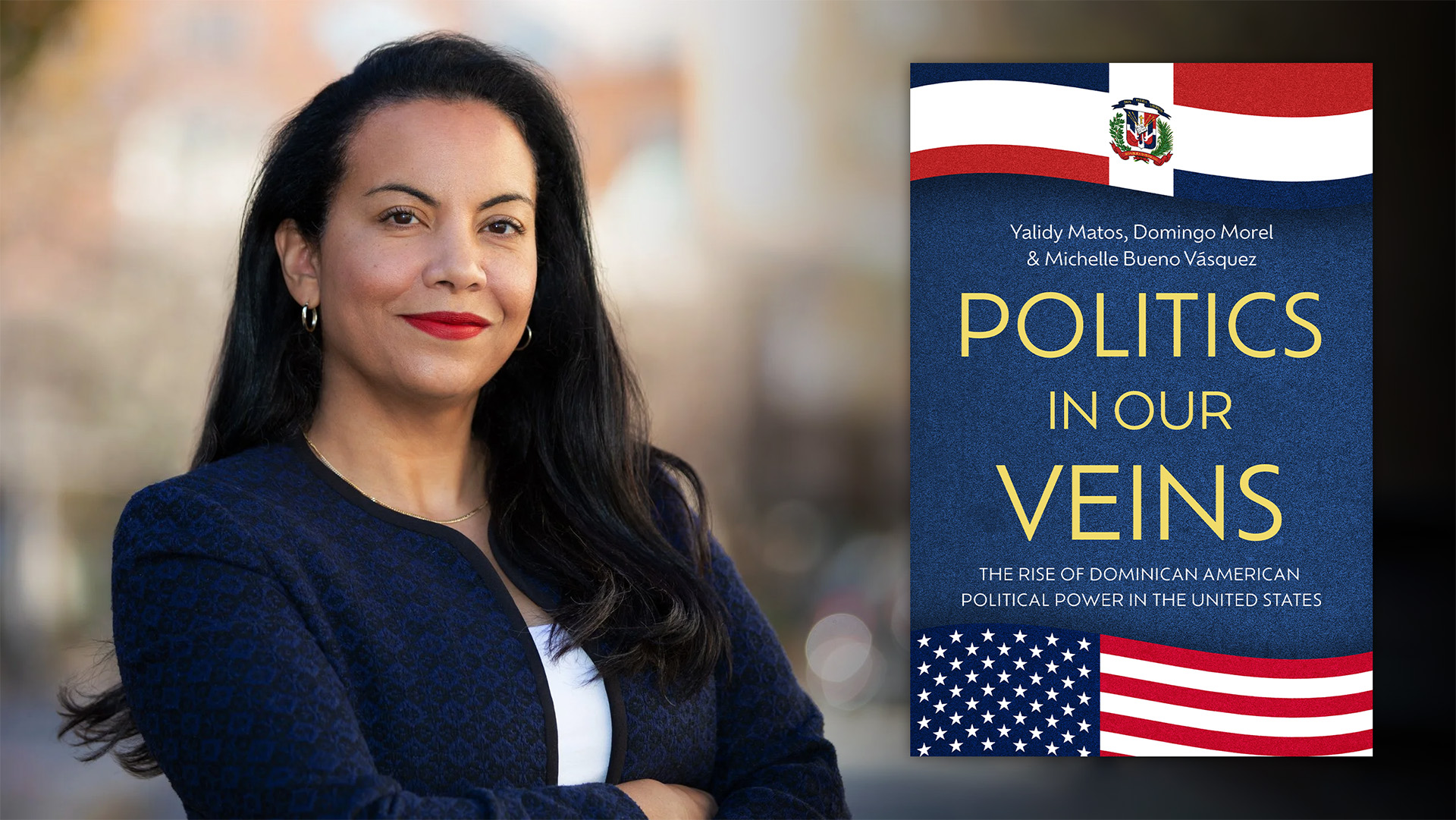
, Domingo Morel and Michelle Bueno VásquezPolitics has always been in our veinsOn April 16, 2026, Analilia Mejía won New Jersey’s 11th Congressional District special election by 41 points, becoming the second Latina to represent New Jersey in Congress and the first ever Afro-Latina to serve in Congress. Daughter of Colombian and Dominican immigrants and a former union organizer, Mejía ran on a platform of radical economic justice and immigrant rights, including abolishing ICE as a top item. Even so, she won decisively in a district that had shifted toward Trump just months prior. [1]Her victory surprised many, but not us. In our bookPolitics in Our Veins: The Rise of Dominican American Political Power in the United States, we detail how moments like this become possible for Dominican migrants and their descendants. We show why victories like Analilia Mejía’s are not isolated incidents but they represent an extensive political groundwork sowed with the efforts of generational resistance, community, and the quintessential Dominican fervor for politics. A community that built its own tableDominican Americans are one of the largest and fastest-growing Latinx groups in the United States, with a community that has quadrupled from roughly 517,000 in 1990 to more than 2. 3 million today. Yet for most of that time, scholars, journalists, and political operatives treated Dominican political life as a footnote, as something concentrated in the New York City metro area, least of all a national phenomenon. As the population has exploded so has the number of Dominican elected officials, growing incrementally at the local and federal levels. This is no coincidence: even when compared with Latino subgroups with larger populations, Dominicans are winning elections at equal or higher rates. That success is no longer confined to the New York metro area. Today, there are Dominican elected officials as far west as Colorado and Arizona–and in rural suburban towns alike. Rather than demanding a seat at the political table, Dominicans built their own coalition through extensive effort, resilience, and grit. From fighting for inclusion on New York City school boards and in local organizations, Dominicans laid the foundation for broader civic infrastructure to represent the community’s interests in the U. S. As the diaspora expanded, so did its political reach, winning elections not through influential donors and overflowing coffers, but through the power of community ties, networks, and showing up when and where it counts. Race, gender, and the complexity of belongingAnalilia Mejía’s candidacy illustrates one of our book’s core arguments: that Dominican Americans navigate a distinctive position in the U. S. racial and gender landscape. Mejía is simultaneously Latina, Afrodescendant, a mother, and the daughter of immigrant parents. As a “proud Afro-Latina,” Mejía’s story is similar to that of the many Afro-Latinas we interviewed for the book. [2]Take for example, Kendra Lara, a Black Latina former Boston City Councilmember, who, at the age of 15, started organizing for housing justice, or Karines Reyes, an Afro-Latina New York State assemblymember and a registered nurse who started her career as a labor union representative, or Grace Diaz, an Afro-Latina State Representative from Rhode Island, and the first Dominican women elected to the state legislature who was also a labor organizer before running for office. At a young age, Analilia Mejía started her career as a union organizer, fighting for the most marginalized citizens and communities. Dominican American elected officials have expanded the ways we understand minority politics in the United States. Political incorporation for our community is shaped by the intersection of race, gender, and national origin as much as by the institutional and social context and timing in which a candidate decides to run. Why this moment matters for the future of Dominican politicsShortly after the special election, Mejía was sworn in on April 20. Her presence in Congress, at a moment when immigration enforcement and immigrant belonging are fiercely contested, is not incidental to her Dominican roots. As the many Dominican elected officials highlighted in the book, Dominican identity is indivisible from the activism in our blood. The political incorporation of Dominican Americans is not a niche story: it is a window into the potential of a working democracy, who gets in, who gets left out, and what it takes to change this. Politics in Our Veins: The Rise of Dominican American Political Power in the United Statesis available now from NYU Press. [1]https://www. democracynow. org/2026/4/17/headlines/progressive_democrat_analilia_mejia_wins_special_election_for_new_jersey_house_seat[2]https://www. analiliafornj. com/biographyYalidy Matosis Associate Professor of Political Science at Rutgers University. She is the author ofMoral and Immoral Whiteness in Immigration Politics. Matos has been the recipient of the 2022 American Political Science Association Distinguished Junior Scholar in Political Psychology Award and a 2024-2025 Russel Sage Foundation Visiting Scholar. Domingo Morelis Associate Professor of Political Science and Public Service at the Robert F. Wagner School of Public Service at New York University. He is the author and co-editor of several books, includingTakeover: Race, Education, and American Democracy, which won the W. E. B. Du Bois Distinguished Book Award, and most recentlyDeveloping Scholars: Race, Politics, and the Pursuit of Higher Education. Michelle Bueno Vásquezis a Doctoral Student in Political Science at Northwestern University.