China Turning Tibet Into Military Buffer Against India? Intel Flags 'Twin Strategy' Along LAC
NewsindiaChina Turning Tibet Into Military Buffer Against India? Intel Flags 'Twin Strategy' Along LACLast Updated:August 06, 2026, 15:42 ISTIndian intelligence says Beijing is erasing Tibet's Buddhist. . .
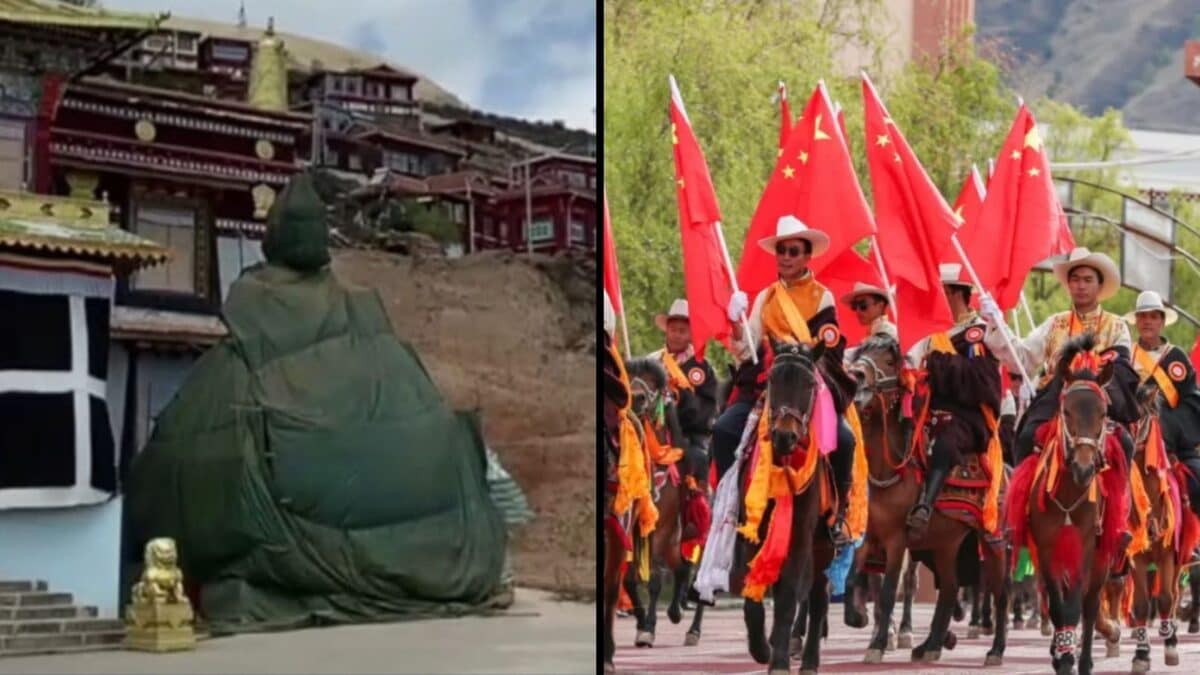
NewsindiaChina Turning Tibet Into Military Buffer Against India? Intel Flags 'Twin Strategy' Along LACLast Updated:August 06, 2026, 15:42 ISTIndian intelligence says Beijing is erasing Tibet's Buddhist identity while building dual-use infrastructure to strengthen the PLA's position along the LACRapid ReadRapid ReadSummarized by AI. +India flags China's dual Tibet strategy: erasing Buddhist identity (sacred sites to racecourses) & building dual-use PLA infra on LAC. This cultural assimilation & militarization raises India's security concerns. Buddha statue wrapped in black plastic and bound outside a demolished annex building at Drago Monastery (Left); and Tibetan cultural performers at a Chinese Communist Party-named Red Folk Songs concert (Right). (Image: Guoma Media)China is pursuing a two-pronged strategy in Tibet—systematically erasing the region’s Tibetan Buddhist identity while simultaneously building dual-use infrastructure that could strengthen the People’s Liberation Army’s (PLA) operational capabilities along the Line of Actual Control (LAC), top Indian intelligence sources told CNN-News18 on Thursday. The assessment comes as fresh evidence, including satellite imagery, eyewitness accounts and Chinese state media reports accessed through a report by Tibet Watch, points to the demolition and repurposing of one of eastern Tibet’s prominent Buddhist landmarks. Recommended StoriesLashkar Behind Attack On Chhattisgarh Workers In J&K's Kulgam: Top Intel SourcesPakistan Eyes Self-Funding $1. 8 Bn Karakoram Highway Project As China Delays Financing | ExclusiveChina’s Silent Cyber Strikes On US: Decoding 7 Espionage, Covert Infiltration Ops | ExclusivePlugging The Proxy Pipeline: Decoding India’s High-Stakes Overhaul Of FCRA Oversight | ExclusiveAccording to the report, authorities in Drago County in Tibet’s Kham region have transformed the site of a revered 99-foot Buddha statue in Sengdeng village into a racecourse named the “Drago County Red Army Cavalry Division Racecourse". The site, once known locally as the “People’s Buddha", had served as a focal point for Tibetan Buddhist worship, where devotees gathered daily for circumambulation. Built through community donations, the statue was intended to protect the region from earthquakes after the devastating 1973 quake during China’s Cultural Revolution. However, since 2023, the county government has hosted state-sponsored sports and cultural festivals at the site to promote Communist Party narratives under what Beijing calls “Red Tourism". According to Tibet Watch, local Tibetans have likened the transformation to a “second Cultural Revolution", saying a sacred religious space has been replaced with a symbol glorifying the Chinese Communist Party and the People’s Liberation Army. ‘Development’ With A Military PurposeIndian intelligence officials say the redevelopment is part of a broader strategy that extends beyond cultural assimilation. “China’s development projects across Tibet are not purely civilian," top intelligence sources told CNN-News18. According to the assessment, infrastructure being built under the banner of tourism, sports facilities and rural development is designed with dual-use capabilities, enabling rapid deployment of PLA troops, heavy military vehicles and logistics support close to the India-China frontier. Officials believe Beijing is steadily converting Tibetan settlements into military-support zones that could be activated during any future crisis along the LAC. The intelligence assessment also points to increasing militarisation of frontier communities through programmes targeting Tibetan children. Under initiatives carrying titles such as “I Am A Little Border Patrol Guard", young Tibetan children are reportedly trained from an early age to become part of local border militia networks known as Liba, reinforcing China’s security architecture in border regions. Changing Tibet’s DemographyIndian intelligence sources further claim Beijing is encouraging migration by Han Chinese into strategically important parts of the Tibetan Plateau. The objective, they say, is to gradually alter the demographic balance by reducing the relative presence of native Tibetans in sensitive frontier districts adjoining India. Parallel to demographic changes, authorities have expanded the mandatory use of Putonghua (Mandarin Chinese) in schools and public institutions, while Tibetan language, script and cultural education are increasingly being marginalised. Analysts believe these policies are intended to weaken Tibetan cultural identity over the long term by disconnecting younger generations from their language, history and religious traditions. Strategic Stakes For IndiaOfficials also warn that Tibet’s significance extends far beyond territorial control. The Tibetan Plateau contains the headwaters of major rivers, including the Brahmaputra, Indus and Sutlej, making it one of Asia’s most strategically important water sources. According to Indian intelligence, replacing traditional Tibetan communities with state-controlled institutions, combined with the construction of dams and other infrastructure, could provide Beijing with greater strategic leverage over downstream countries such as India and Bangladesh. Rewriting Tibet’s IdentityThe intelligence assessment also highlights China’s growing use of the term “Xizang" in place of “Tibet" in official international communications. Officials describe this as more than a linguistic change, arguing it is part of a broader legal and diplomatic effort to redefine Tibet as an inseparable administrative region of China while weakening the historical and civilisational identity associated with the name “Tibet". According to the assessment, such moves are intended to bolster Beijing’s territorial claims internationally, including along disputed Himalayan frontiers. For Indian security agencies, the developments point to a coordinated strategy in which cultural assimilation, demographic engineering and military infrastructure are advancing together, with implications not only for Tibet’s identity but also for the evolving security landscape along India’s northern borders. News18 NewsletterHandpicked stories, in your inboxA newsletter with the best of our journalismAbout the AuthorManoj GuptaGroup Editor, Investigations and Security Affairs, Network18Location :First Published:August 06, 2026, 15:42 ISTDisclaimer: Comments reflect users’ views, not News18’s. Please keep discussions respectful and constructive. Abusive, defamatory, or illegal comments will be removed. News18 may disable any comment at its discretion. By posting, you agree to ourTerms of UseandPrivacy Policy. Loading comments. . . Read More