DA’s Expropriation Act challenge begins in Western Cape High Court - Inside Politics
The Western Cape High Court on Monday started hearing the Democratic Alliance’s (DA) challenge to the Expropriation Act, with the party saying that the legislation threatens private property rights and was passed through an unlawful parliamentary process.
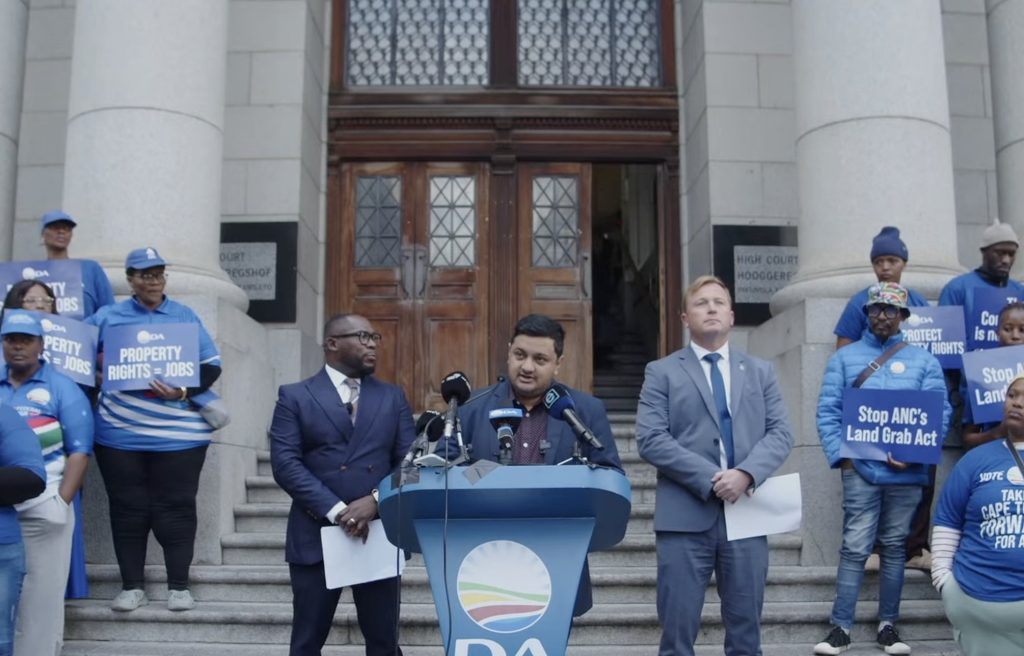
’s (DA) challenge to the Expropriation Act, with the party saying that the legislation threatens private property rights and was passed through an unlawful parliamentary process. The DA filed its application challenging the constitutionality of the Act in February 2025. Its case is being heard alongside other legal challenges to the legislation. Speaking outside the court in Cape Town, DA Federal Council Chairperson Ashor Sarupen said the case was one of historical importance, given South Africa’s history of forced removals and arbitrary deprivation of property during Apartheid. He said the country needed legislation that strengthened human rights protections, safeguarded investment and gave property owners greater certainty. ALSO READ:Cold mornings and coastal showers expected across SA this week“What we need is stable legislation that attracts investments,” he said. “[It must] ensure that people can build inter-generational wealth…and protect as many rights as possible. Not erode rights. ”The DA’s application names President Cyril Ramaphosa, the Minister of Public Works and Infrastructure, the Speaker of the National Assembly, the chairperson of the National Council of Provinces and several provincial legislatures as respondents. Ramaphosa assented to the Expropriation Act 13 of 2024 in December 2024, with the Presidency publicly announcing the decision on 23 January 2025. The legislation is intended to repeal and replace the Expropriation Act of 1975 and establish a framework aligned with section 25 of the Constitution. The Presidency said the legislation recognised expropriation as an important mechanism through which the state could acquire property for a public purpose or in the public interest, subject to the payment of just and equitable compensation. It said the Act prohibited arbitrary expropriation and required an expropriating authority to first attempt to reach an agreement with the owner or holder of a right in the property on reasonable terms. “Expropriation may not be exercised unless the expropriating authority has without success attempted to reach an agreement with the owner or holder of a right in property for the acquisition thereof on reasonable terms,” the Presidency said at the time. The Act also identifies circumstances in which nil compensation for land may be considered just and equitable. Sarupen said the DA’s case was based on the protection of property rights under the country’s constitutional democracy. “We will not accept a bill that legalises land grabs,” he said. The party is challenging both provisions of the Act and the process followed when the legislation was passed by Parliament. Its substantive challenge focuses partly on section 19(2), which allows either party to approach a court within 180 days of a notice of expropriation when compensation has not been agreed through negotiation or mediation. The DA argues that the provision creates an irrational and contradictory process for property owners seeking to dispute compensation. It is also challenging the final mandates used when the National Council of Provinces voted on the Bill. Parliament’s official record shows that seven provinces voted in favour of the legislation. Under the Constitution, a Bill of this nature requires the support of at least five provinces to pass. However, the DA alleges that five of the seven provinces recorded as supporting the Bill did not have legally valid final mandates authorising their NCOP delegations to vote in favour. ALSO READ:Ramaphosa says PIC governance changes will protect pension savingsThe party says that, if those five votes are declared invalid, the Bill would have received only two lawful provincial votes and would therefore not have met the constitutional threshold. Parliament disputes the allegation and maintains that the legislation was lawfully supported by seven provinces. “On either argument, the Expropriation Act was passed unconstitutionally, and it must be declared invalid. So the DA is fighting today for property rights,” Sarupen said. INSIDE POLITICS