Going To China? Your Hotel Room, Phone And Chats May Not Be Private, US Warns Americans | Exclusive
News world Going To China? Your Hotel Room, Phone And Chats May Not Be Private, US Warns Americans | Exclusive Last Updated: August 18, 2026, 10:45 IST The US State Department’s China travel guidance. . .
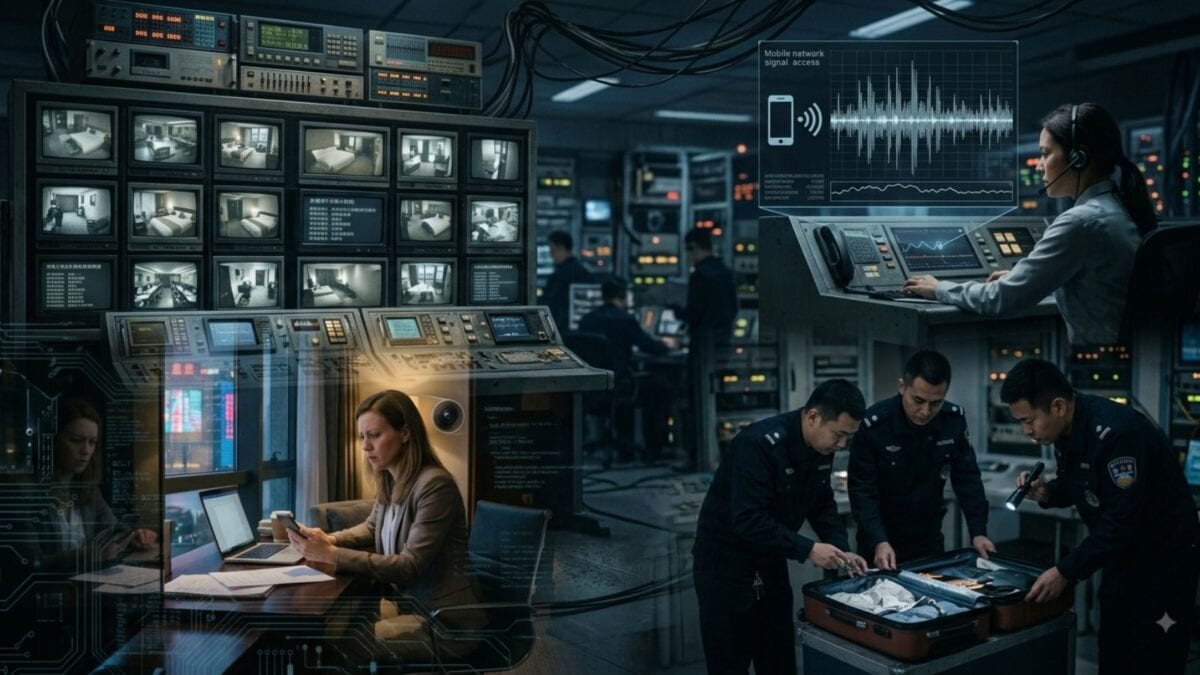
NewsworldGoing To China? Your Hotel Room, Phone And Chats May Not Be Private, US Warns Americans | ExclusiveLast Updated:August 18, 2026, 10:45 ISTThe US State Department’s China travel guidance warns that Americans should have “no expectation of privacy” and personal belongings can be searched without consentRapid ReadRapid ReadSummarized by AI. +The US State Dept. warns Americans in China: Expect no privacy due to widespread surveillance. Hotels, phones, chats, and belongings are searched without consent. Critical messages risk detention/deportation; exit bans are also a major risk. The US guidance says Chinese internet and mobile service providers are required to provide intelligence and security services with on-demand access to data, networks and related infrastructure. (AI-Generated Image)For Americans travelling to or living in China, privacy may not stop at the hotel-room door, or even inside a private chat. The US State Department’s China travel guidance warns that Americans should have “no expectation of privacy" when using mobile or other networks in the country. It says Chinese authorities closely monitor foreign visitors and that hotel rooms, offices, cars, taxis, telephones, internet use, digital payments and fax machines can all be monitored either remotely or on site. Recommended StoriesCordless Power Drill Kits That Are A Must-Have For Your Home DIY ProjectsThe New War On Iran-Backed Hezbollah Isn’t About Weapons. It’s About Money. Here’s WhyOpinion | The Freedom To Choose: Modi’s I-Day Speech And India’s Case For A Multipolar WorldOpinion: UPI Did Not Kill the Tollbooth, It Moved ItThe warning goes further: personal belongings kept in hotel rooms, including computers, can be searched without consent. US authorities also say Chinese security personnel have detained and deported American citizens for sending private electronic messages critical of the Chinese government. For travellers accustomed to treating a private WhatsApp conversation, an email or a laptop as personal space, the advisory paints a dramatically different picture. Your Phone May Not Be PrivateThe US guidance says Chinese internet and mobile service providers are required to provide intelligence and security services with on-demand access to data, networks and related infrastructure. That is why the State Department advises many travellers to consider carrying personal electronics containing no sensitive or proprietary information while in China. It specifically warns that hotel rooms, offices, cars and taxis can be monitored, while telephones, internet use and digital payment systems are also subject to surveillance. The department also cautions that Chinese authorities widely monitor domestic social-media platforms and can act on content they consider critical, controversial or potentially illegal. The practical implication is stark: a foreign visitor cannot necessarily assume that a conversation is private simply because it happens behind a closed door or on a personal device. A Private Text Can Become A Security IssueOne of the most striking claims in the US advisory concerns private electronic messages. According to the State Department, Chinese security personnel have detained and deported US citizens for sending private electronic messages critical of the governments of China, Hong Kong or Macau. That warning sits within a broader concern about China’s national-security framework, where authorities have considerable discretion over what can constitute a security violation. The US says Chinese authorities can classify a wide range of documents, data, statistics and other material as state secrets. It also warns that Americans conducting research or even accessing publicly available material could face detention or prosecution if authorities consider the activity sensitive or a national-security risk. China’s updated Counterespionage Law, which took effect in 2024, has broadened the definition of espionage and increased the emphasis on public participation in identifying suspected spies, according to the US advisory. That creates an environment in which information that may appear routine or innocuous elsewhere can potentially attract official scrutiny. The Other Risk: You May Not Be Allowed To LeaveSurveillance is only one part of the warning. The US says China also uses exit bans, restrictions preventing individuals from leaving the country, as an instrument of law enforcement and political leverage. The State Department says Americans and other foreigners can be subjected to exit bans without a fair and transparent process. Such restrictions can be used to compel participation in investigations, pressure relatives abroad, settle civil disputes or gain bargaining leverage over foreign governments. Perhaps more troubling for travellers, Americans may not even discover that an exit ban has been imposed until they try to leave China. The advisory says there may be no available legal process through which an affected individual can challenge an exit ban in court. In some cases, restrictions can last for years. Why Beijing Is So Sensitive About ForeignersThe underlying concern is China’s increasingly expansive interpretation of national security. Beijing has tightened scrutiny of foreign companies, researchers, consultants and other professionals amid concerns about espionage, sensitive data and foreign influence. The US specifically warns that professional-services and due-diligence firms have faced increased official scrutiny, while researchers can attract attention for collecting information that might appear publicly available. For Chinese authorities, the logic is tied to protecting state secrets, strategic industries, economic information and other sensitive data. For foreign businesses and researchers, however, that creates uncertainty over where legitimate professional activity ends and a potential national-security concern begins. The result is an unusually broad security environment in which physical spaces, digital communications and personal information can overlap with national-security enforcement. China’s Double-Edged Approach To ForeignersThe warnings come against the backdrop of increasingly complicated US-China economic ties. China continues to court foreign investment and international business even as its security apparatus subjects some foreign nationals and companies to heightened scrutiny. That apparent contradiction—welcoming foreign capital while expanding the state’s ability to monitor and restrict foreigners—is at the heart of the privacy concern. For Beijing, tighter surveillance can be justified as necessary to protect sensitive information and prevent espionage. For Washington, the same powers create a risk of arbitrary enforcement and limited protection for Americans caught on the wrong side of China’s security laws. The US State Department currently advises Americans to “exercise increased caution" in China because of the arbitrary enforcement of local laws, including exit bans. It says foreign nationals including businesspeople, academics, journalists and former government personnel have faced interrogation and detention under national-security laws. The Message From WashingtonThe warning essentially asks Americans to change how they think about privacy before entering China. Don’t assume a hotel room is private. Don’t assume a personal laptop is beyond inspection. Don’t assume a taxi ride or digital payment is invisible. And, most importantly, don’t assume a private political message will remain private. The broader issue is not simply whether China operates a sophisticated surveillance system. It is the combination of surveillance, broad national-security laws and the power to restrict a person’s ability to leave the country. For an American visitor, that can turn an ordinary business trip, research project or holiday into a very different proposition. In China, according to the US warning, the question is no longer simply “What are you doing?" It can also be “Who is watching and what happens if they don’t like what they see?"News18 NewsletterHandpicked stories, in your inboxA newsletter with the best of our journalismAbout the AuthorManoj GuptaGroup Editor, Investigations and Security Affairs, Network18Location :Beijing, ChinaFirst Published:August 18, 2026, 10:45 ISTDisclaimer: Comments reflect users’ views, not News18’s. Please keep discussions respectful and constructive. Abusive, defamatory, or illegal comments will be removed. News18 may disable any comment at its discretion. By posting, you agree to ourTerms of UseandPrivacy Policy. Loading comments. . . Read More