How Are Major Decisions Made by the CPC? | China Responds
As the Communist Party of China marks its 105th anniversary, Professor Zheng Changzhong explains how major policies are made through research, consultation, and collective decision-making. It is a process that combines scientific analysis with democratic participation from the masses to the masses
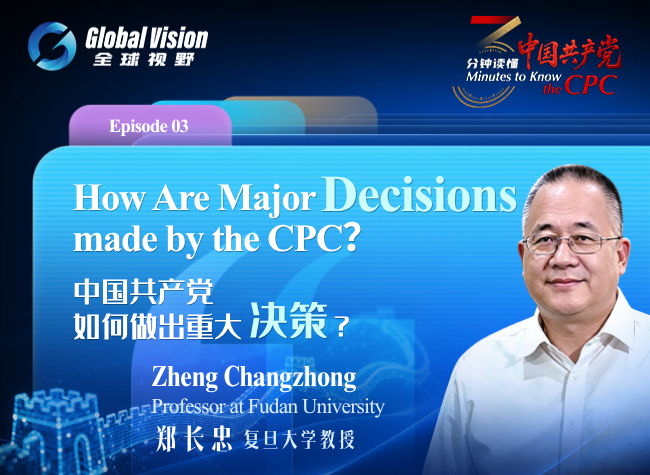
ByXUDONG YANG|Jul 01,2026Chongqing- In 2026, the Communist Party of China (CPC) marks its 105th anniversary. Over more than a century, CPC has developed a governance system through which major national policies are formulated and implemented. But how are these policies made? From grassroots research to final approval, what process does a major decision go through?According to Zheng Changzhong, Professor at Fudan University, China's policymaking process is guided by two principles: respecting the laws of development and adhering to the mass line. "The process of making major decisions in China is a closed loop—from the masses, to the masses," Zheng said. Rather than being made behind closed doors by a small group, he said, major policies are developed through research, consultation, and collective deliberation. China's major national decisions originate with the Communist Party of China Central Committee, which sets the country's overall strategic direction. To support policymaking, senior officials conduct field research, while Party organizations, government agencies, deputies to the National People's Congress, members of the Chinese People's Political Consultative Conference, think tanks, the media, and online consultation all contribute information and public feedback. "It makes sure that decisions are always based on actual conditions, rather than being made arbitrarily," Zheng said. The information is then analyzed and discussed under the leadership of the Party Central Committee before policies are finalized. According to Zheng, scientific analysis and democratic consultation are combined throughout the process. After extensive consultation and discussion, decisions are made according to the principle that the minority is subordinate to the majority, a process known as democratic centralism. "Scientific decision-making and democratic decision-making are highly unified," Zheng said. Overall, China's policymaking process seeks to combine investigation, consultation, and collective decision-making in a continuous cycle from the masses to the masses. RELATED ARTICLESMORE FROM AUTHORInternet illegal and undesirable information can be reported by calling this telephone number:+86-23-67158993渝ICP备20009753号-2互联网新闻信息服务许可证号:50120220004