How I Wrote Disrupting Politics
Hi, I’m Katie 👋 I spent a decade running Facebook’s global elections work, through 2016, Cambridge Analytica, and the congressional hearings that followed. I left in 2021 and started Anchor Change, this. . .
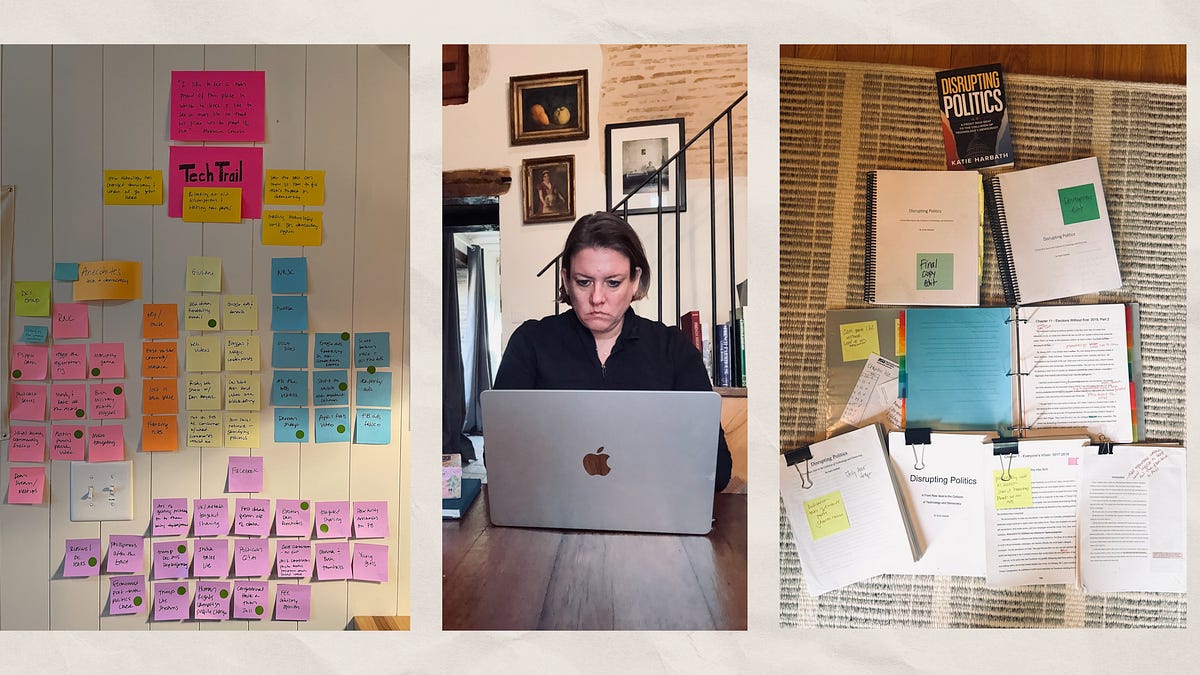
Hi, I’m Katie 👋I spent a decade running Facebook’s global elections work, through 2016, Cambridge Analytica, and the congressional hearings that followed. I left in 2021 and started Anchor Change, this newsletter, to keep making sense of where technology and politics collide, without a company line to protect. Disrupting Politics, out October 6, is the book version of that same question: what does it actually look like from inside the room when these decisions get made? This piece is part of a series on how I actually wrote it. If you’re new here, welcome. Subscribe below and you’ll get the rest of what I write on tech, politics, and the impossible tradeoffs in between. This is as much a how-to as it is a story. If you’re sitting on your own pile of stories, wondering how you’d ever actually start putting them together into a book, here’s what five years of mine looked like, start to finish. My journey started with a weekend alone at a cabin in Virginia, a few hours outside of DC. It was early 2021, we were still deep in COVID, and I’d brought a pack of Post-it notes, Sharpie markers, and a few bottles of wine. The stories of the last twenty years were in my head; that part I knew. What I didn’t know was which ones mattered and which didn’t. I’d been telling the same handful over and over for years, at dinners, on panels, in interviews, and I needed to get all of them out of my head and onto something physical before I could figure out what actually belonged in a book. So I started sticking notes to the wall, one moment per note, no editing, just getting it out of my body and onto something I could see. By the end of the weekend, the wall looked like a crime board. The beginning of mapping out the book. More Post-it work followed, at home and on the Eastern Shore, and I wrote an early draft of the first chapter that opened chronologically, in 2004, with the campaign work, because that felt like the obvious place to start. A friend and former colleague who had written a book introduced me to Roseanne Cheng atEvergreen Authors, who gave me some real talk about the publishing world and helped me put together a first proposal thatI struggled to get attention for. So, I put it on the back burner. I made the call to spend time building Anchor Change instead, growing the newsletter, and giving myself some distance from the story before I tried to tell it. The proposal sat, but the work didn’t. In 2022, I pitched a project with Collier Fernekes at the Bipartisan Policy Center to write abrief history of tech and politics. I thought of it as book research from the start. Collier helped me do some of the research, as well as a contractor I found on Upwork. I knew I was still a couple of years out from actually sitting down to write, and this gave me a way to keep working through the material in the meantime instead of losing the thread entirely. 2024 and 2025 are where it actually got hard, because I signed with Indigo River and knew I needed to start writing if I wanted the book out before the 2026 midterms. Once I had a contract signed, I thought I could easily start writing the book. My psyche had other plans. I had genuinely bad writer’s block, the kind where you know exactly what you’re supposed to do, my coach kept telling me, and every book on writing kept telling me:just sit down and write it, and you still can’t make yourself do it. The thing felt enormous. I wanted to know exactly what I’d write and how before I let myself start. I worked with a writing coach,Chelsey 🔮 Tarot for Creativity, beginning in August 2024, and I read every book on craft I could find, from Stephen King’sOn WritingtoElizabeth Gilbert’sBig Magic. Partly, that was genuine curiosity. Partly, it was a well-disguised form of procrastination. Somewhere in there, I also had to admit that the newsletter, the thing keeping me sharp and keeping my audience alive, was also the thing eating the time I needed for the book. It was hard to context-switch between writing the newsletter and writing the book. Some people said to just commit to a thousand words a day, but that was never going to work with my life. What finally worked for me was a distant location and setting aside dedicated time. I went to visit a friend in Paris that fall, partly to see if I could get real writing done, and partly because I hadn’t traveled in a few years and missed Europe. I ended up working on the political ad transparency chapter in the mornings, because I’d discovered something useful: America was asleep for most of my day in France. No inbox or message threads pulling at me. That trip is what got me to bookKate Hill’swriting retreatin the south of France in February 2025. I spent two weeks there and wrote 30,000 words in 10 days. I gave myself a schedule and stuck to it: write from nine to noon, break for lunch and a walk, write again from one to four, then around five, open a bottle of really nice three-euro Bordeaux wine and handle whatever the rest of my work life needed that day. It was the first time in this whole process that writing felt less like an obstacle and more like a rhythm I could live inside. I’ll write separately about how I used AI tools during the editing process, but the first full draft itself was written the old-fashioned way, sentence by sentence, on my laptop. Writing the first draft at the kitchen table atRelais de Camontin February 2025. France gets the most attention because it’s where the bulk of the words landed. But this book was written in pieces, everywhere. On a fishing boat in northern Canada. In the car. In enough airports that I have a specific memory of standing at a gate at Reagan National in November 2024, recording a voice memo to myself about how a chapter should be structured, because the thought had shown up right then and I didn’t trust myself to remember it later. Very little of it actually happened at my regular desk. None of those bursts felt like progress at the time. Looking back, they’re the little steps that made most of the book. Disrupting Politics: A Front Row Seat to the Collision of Technology and Democracyis now available for pre-order — start with the ebook today, with paperback and audiobook pre-orders opening in the weeks ahead. All formats release on October 6. Pre-Order HereI let the draft sit for a couple of weeks after France. Then I read the whole thing in one sitting, one weekend at the shore, just to feel what it was as an entired story rather than as a pile of chapters. Sarah Wynn-Williams’Careless Peoplecame out around that same time, and reading it while I was reading my own draft back was strange in a useful way. It gave me language for what I didn’t want this book to be and some clarity on what I did. One thing became obvious in that read-through: I’d been trying to write two books at once, part journalistic history of the last twenty-five years of tech and politics, part my own story. I realized that I let go of the history-book instinct and accepted that this could only be my story. Everything got sharper once I stopped trying to cover everyone else’s version of events, too. From March 2025 to around October, I went through five or six rounds of edits before my editor felt it was ready for developmental editing. Developmental editing focuses on the overall structure of the story rather than grammar and sentence structure. I also brought in my friend Morgan, who I’d moved to DC with years ago and who knows my story and the vibe I was going for better than almost anyone. She went through the first draft and gave me some of the sharpest notes I got, including that I needed more context anchoring for each year, so readers could locate themselves in the timeline the way I could. I also asked some trusted friends, colleagues, and even my high school English teacher to read various chapters. For some, I asked for their opinion on whether I was portraying certain events correctly. Others, if I asked if the international part of my story was enough. Another question: would someone who didn’t follow the Facebook drama so closely stay interested? Finally, I also wanted someone to look at it through a political lens and see where I might be most likely to be criticized or attacked. When the developmental edit notes came back, I printed the entire manuscript, put it in a binder, and spent two to three weeks going through it on airplanes and in hotel rooms with a highlighter and a red pen, physically figuring out where sections wanted to live. Paper let me see the whole shape at once in a way scrolling on a screen never could. During the line edit (this is where you are making sure each sentence makes sense), I was hunting for repetitive words (this is where AI was really helpful) and finally tackling citations, all at once, to meet my editor’s preferences. She wanted me to cite as I went. I knew I wouldn’t know what actually needed a citation until the manuscript was closer to final, so I held out, and I’m glad I did, even if it did take me two twelve-hour days in November to create over 300 footnotes. I wrote most of the book in Google Docs because I needed something I could work on from anywhere. Scrivenerhelped me compile everything into one document to print. My editor wanted Microsoft Word, so that’s where it lived once we hit developmental edit. The copy edit (checking spelling and that punctuation is right) was quiet by comparison. It was a weird feeling to have to be ready to put it down. After years of being able to open the file whenever I wanted, that took some getting used to. All the versions of my book through the editing process. I originally thought I would write the book purely in chronological order and I was resisting starting with Facebook or Trump because I wanted the book to be more than that. However, I also realized I needed something most readers would recognize and remember, so I chose the day after the 2016 election for the prologue and then went back in time for the first chapter. The ending evolved over the years. The 2021 version of this book ended around January 6th, with leaving Facebook as the natural close. But giving myself more time changed what I could see. I started noticing how much was still evolving, the pivots, the advent of AI, and I realized that pause, the thing that felt like a delay at the time, was actually what let this book zoom out more. I knew the actual end date the moment I saw it: the tech CEOs at the 2025 inauguration. That was right before I left for France to write that chapter, and it felt like a natural bookend without my forcing it. I went back and forth a few times that year about whether to stretch it toCareless Peopleor to some other moment, and each time I decided no. Twenty-five years is the arc. I can always write a future edition with new chapters. I also wanted the book to be more of a history since any forward-looking tech book is usually out of date before it is even released. I want people to go to my newsletter for more of what is happening now. Somewhere early in this process, I stopped thinking of this as just a book and more a part of a project. The book is the history of twenty-five years, contained and finished. But it was never going to be the whole project because I want the book to drive people to this newsletter to engage with what is happening today with technology. I worried that if I was too forward-looking in the book, it would be out of date before it was even released. I decided to build a podcast around it to amplify the stories of others who were part of these times. That will likely come late this year or early next year. There will be social videos, and this newsletter series walking through how the whole thing actually got made is part of it too. I expect I’ll keep adding to this over time, and I’m fine with the book itself staying fixed while everything around it keeps moving. Thinking of the book as one piece of something larger, instead of the whole thing I had to get right in one shot, took a lot of the pressure off. Next up: how I actually used AI tools during this process, and where they helped and where they very much didn’t. If this helped you connect some dots, consider sharing it with someone else trying to make sense of where AI, technology, politics, and public trust are all heading next. Word of mouth is still how most people find me, and I’m grateful for every share. ShareNo posts