Johnson denies IDAC tried to ‘taint’ Fannie Masemola in Medicare24 case - Inside Politics
Former Investigating Directorate Against Corruption (IDAC) head Andrea Johnson on Wednesday said there was never any malicious intent behind the decision to charge suspended National Police Commissioner General Fannie Masemola alongside the accused in the Medicare24 tender corruption case.
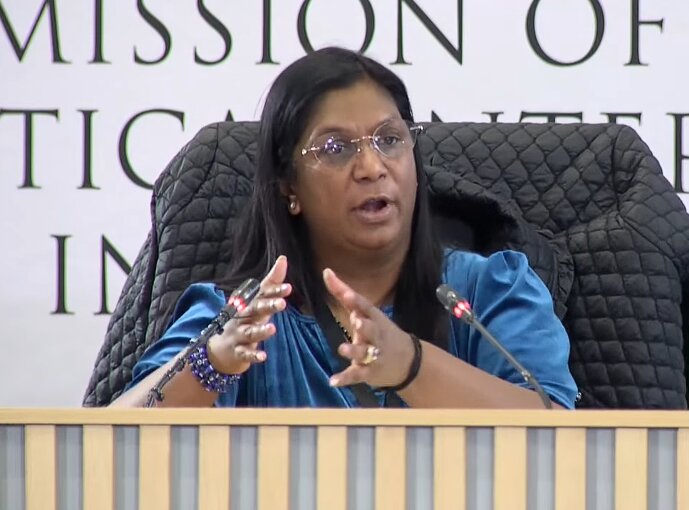
(IDAC) head Andrea Johnson on Wednesday said there was never any malicious intent behind the decision to charge suspended National Police Commissioner General Fannie Masemola alongside the accused in the Medicare24 tender corruption case. Resuming proceedings on the sixth day of her testimony before the Madlanga Commission, Johnson maintained that no mala fide intention lay behind the inclusion of Masemola, who faces four counts of contravening the Public Finance Management Act (PFMA), in the same prosecution as the main accused in the Medicare24 wellness tender. Former Investigating Directorate Against Corruption (IDAC) head Andrea Johnson on Wednesday said there was never any malicious intent behind the decision to charge suspended National Police Commissioner General Fannie MasemolaThe tender had an estimated budget of R360 million, while the contract was awarded for approximately R228 million. “I have to clarify, there was never an ill intent. It might have been clumsily put in the way it is, or incompetently put, but that does not make for ill intent at all,” Johnson said. SAPS Chief Risk Officer Major-General Charity Matlou’s affidavit formed a central part of the commission’s examination of the case against Masemola. ALSO READ:MK Party centralises power under Zuma as new leadership team takes over party operationsIn the affidavit, Matlou said she reasonably suspected that procurement processes surrounding the Medicare24 Tshwane District contract had been manipulated to unlawfully benefit company owner Vusimusi “Cat” Matlala and that corruption and money laundering may have been committed to the prejudice of SAPS. She stated that she had advised Masemola to terminate the contract “to save the SAPS from irreparable harm” and that he eventually cancelled it in May 2025, by which time SAPS had paid Medicare24 about R50 million. However, commissioners repeatedly pointed out that the affidavit itself did not allege that Masemola ignored her advice, delayed unreasonably or committed any criminal offence. Johnson conceded that the affidavit did not specify when Matlou warned Masemola or expressly accuse him of failing to act, although she maintained that this was her interpretation of the document. The commission also closely examined whether there was a proper legal basis for joining Masemola to the Medicare24 prosecution under the Criminal Procedure Act. Commission chair Mbuyiseli Madlanga referred Johnson to sections 155 and 156 of the Act, which regulate when accused persons may be charged and tried together. Madlanga said section 155 applies to participants in the same offence, while section 156 permits people accused of separate offences committed at the same place and at the same or approximately the same time to be tried together where evidence admissible against one would also be admissible against another. ALSO READ:Johnson concedes Nkosi allegations against IDAC ‘extremely serious’ as commission probes Medicare24 investigationHe questioned why Masemola, who faces only THE statutory PFMA charges, had been charged in the same case as accused facing fraud and corruption charges. Johnson initially relied on section 156 to justify the joint prosecution but ultimately accepted Madlanga’s proposition that Masemola should have been charged separately and could be prejudiced by being tried with those accused of fraud and corruption. Johnson argued that although the accused did not all face identical charges, they were all implicated in what prosecutors regarded as “one serious complex commercial corruption matter. ”Madlanga repeatedly stressed that the commission was not suggesting Masemola had no case to answer, but questioned whether prosecuting him in the same matter fell within IDAC’s statutory mandate, and more importantly, whether it was intended to discredit, humiliate or prejudice the police commissioner. “At face value, it seems to me that this must have been done to embarrass him, to taint him and to make the public or to cause the public to see him as also being complicit in fraud and corruption,” Madlanga said. “So this was done, I suggest to you, to embarrass him, to taint him and to make him look as if he too has committed fraud and corruption. That was calculated, I suggest to you,” he added. The commission further interrogated the substance of the PFMA charges themselves. Johnson maintained that Masemola was charged under section 38 of the PFMA because, as accounting officer of SAPS, he allegedly failed to prevent irregular and fruitless expenditure, failed to manage contractual liabilities, failed to ensure that procurement requirements were met, and failed to stop payments under the contract after allegedly being alerted to irregularities. Evidence leader Mahlape Sello and Commissioner Sesi Baloyi, however, questioned whether those allegations were supported by the evidence. ALSO READ:SARB leading indicator up 4. 2% in May, signaling positive sentimentSello put it to Johnson that responsibility for ensuring the successful bidder’s tax compliance rested with the Bid Adjudication Committee rather than Masemola, a concession Johnson accepted. Baloyi similarly noted that the PFMA provisions relied upon related to SAPS’ own compliance obligations, not the tax compliance of companies contracting with the police, prompting Johnson to again concede that aspect of the case. “What’s problematic with this is the fact that you have already agreed that in terms of the sections, he ought not to have been joined at all. He ought not to have been. Now, what makes the situation worse is the fact that he is being joined down the line,” Madlanga added. The commission continues. INSIDE POLITICS