Johnson testimony ends with a whimper: invokes right to silence, claims possible prosecution - Inside Politics
By Johnathan Paoli Former Investigating Directorate Against Crime (IDAC) head Andrea Johnson has invoked her right against self-incrimination, refusing to answer questions about allegations that she leaked a confidential assault docket to Crime Intelligence deputy head Major-General Feroz Khan, claiming she might be the subject of a pending prosecution. Concluding her testimony on Wednesday afternoon, […]
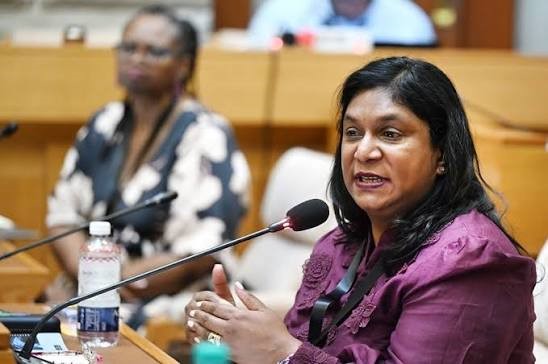
(IDAC) head Andrea Johnson has invoked her right against self-incrimination, refusing to answer questions about allegations that she leaked a confidential assault docket to Crime Intelligence deputy head Major-General Feroz Khan, claiming she might be the subject of a pending prosecution. Concluding her testimony on Wednesday afternoon, Johnson said she would rely on her rights under Section 35(3)(j) of the Constitution, read with Section 3(4) of the Commissions Act, when questioned about evidence given by retired Hawks Colonel Kobus Roelofse, Captain Mark McLean and the protected Witness O concerning the alleged sharing of the docket. “I must at the outset indicate that this is not a decision I make lightly, nor do I make this decision to frustrate the Commission. I have come to the Commission, as I have over several days, and have answered as best I could on all matters,” she said. “This matter, however, affects me directly. I am aware then that should I choose not to answer any of the questions, they remain unchallenged. I elect not to answer questions, so as not to incriminate myself,” Johnson added. But evidence leader Mahlape Sello challenged Johnson’s reliance on the Constitution, arguing that Section 35 protections apply to accused persons and that no decision had yet been taken to prosecute her. “You cannot invoke the rights set out in Section 35 of the Constitution, because those are the rights of an accused person,” Sello said. Sello argued that evidence given before a commission cannot be used directly against a witness in subsequent criminal proceedings. Johnson responded that, while this was legally correct, testimony could still assist investigators. “It can, however, be used by investigators, as has been the case, to roadmap further investigations against you, to enhance and bolster their case,” she said. Commission chairperson Mbuyiseli Madlanga questioned how the statutory protection against self-incrimination could operate in practice if witnesses could always be compelled to testify because their evidence could not be used directly against them. However, he warned Johnson that refusing to rebut earlier testimony carried its own consequences. “Witnesses have given what, on the face of it, appears to be very strong evidence that you did share the docket with General Khan. What could have countered that would have been testimony from you, which, as we now see, you are not willing to do,” Madlanga said. The chair added that previous evidence was so strong, and in light of Johnson’s refusal to testify on the matter, the commission could conclude that those witnesses had been truthful. Johnson replied simply that she understood. Commissioner Sesi Baloyi confirmed that Johnson’s refusal also extended to evidence concerning her alleged interactions with then journalist Barry Bateman, who had allegedly supplied her with the contents of the assault docket before it was allegedly forwarded to Khan. Earlier, Johnson admitted that her relationship with Khan had been significantly closer than she had initially described in a written statement to the commission. Confronted with WhatsApp messages between the pair, Johnson acknowledged that she considered him “a very good friend”. She said they had met for lunch “once or twice” and that she and her husband had attended Khan’s 50th birthday celebration, although she denied that they had ever visited each other’s homes despite joking messages about coming over for dinner. The commission heard that the chats included terms of endearment such as “gorgeous” and “dearest”, discussions about family life and plans to prepare food for Lieutenant-General Hilda Senthumule while she was ill with Covid-19. Commissioner Sandile Khumalo also referred Johnson to messages showing Khan arranging to enter IDAC’s offices through a side entrance to discuss personal concerns that he believed he was being targeted by the Hawks. Johnson initially said senior police officers routinely used the side entrance. Sello interrupted, stressing that Khan “wasn’t coming in his capacity as a VIP” but as a friend seeking a personal favour. The commission also heard Johnson explain why IDAC had not investigated the large-scale corruption allegations linked to Tembisa Hospital. She said the matter fell within the Directorate of Priority Crimes Investigations (Hawks)’ mandate after being referred by the Special Investigating Unit in 2020. “The Tembisa Hospital, whether it’s skinny jeans, whoever they are, who’s behind the scenes, whether Maumela is involved or not, etc. All of it lies within the ambit of the Hawks,” Johnson said. She said she was limited in what she could disclose about the Tembisa Hospital corruption investigations because the progress reports form part of confidential submissions to the Financial Action Task Force (FATF), which are subject to an embargo. She explained that IDAC contributes to monthly multi-agency reports alongside the Hawks, the SIU, SARS and other law enforcement bodies, and that those documents cannot be released publicly without FATF’s approval. Johnson concluded her evidence by expressing hope that the commission’s final report would recommend stronger checks and balances within IDAC to address systemic shortcomings exposed during its inquiry. INSIDE POLITICS