Opening doors to jobs - Business News
A Waikato employment initiative is challenging perceptions about job seekers while helping businesses fill vacancies, plan future workforce needs and tap into talent pools often overlooked by employers, reports Mary Anne Gill. Eleven people recently secured jobs in the Waikato from a recruitment campaign aimed at filling just eight vacancies. The result, achieved through aRead More
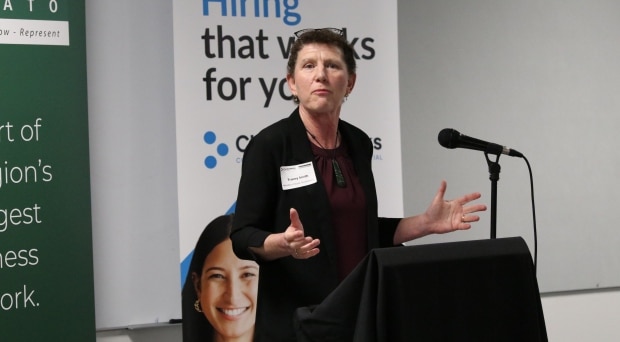
A Waikato employment initiative is challenging perceptions about job seekers while helping businesses fill vacancies, plan future workforce needs and tap into talent pools often overlooked by employers, reports Mary Anne Gill. Waikato Chamber chief executive Don Good, left, with MSD Waikato Regional Commissioner Tracey Smith and Taupō MP Louise Upston. Eleven people recently secured jobs in the Waikato from a recruitment campaign aimed at filling just eight vacancies. The result, achieved through a partnership between JetPark Hamilton and the Ministry of Social Development (MSD), was one of several success stories highlighted at a Waikato Chamber of Commerce and MSD ChamberWorks event in Hamilton attended by Social Development and Employment Minister Louise Upston last month. The JetPark example set the scene for an evening focused on connecting Waikato employers with what speakers described as an often-overlooked pool of skilled and work-ready job seekers. Networking at the ChamberWorks function in Te Rapa, Hamilton were from left Amanda Nicolle (MSD), Joy Foot (Volunteering Waikato) and Hermione Hiku (MSD). Photo: Mary Anne GillMSD Waikato Regional Commissioner Tracey Smith revealed that about 6600 Waikato job seekers had been on a benefit for less than a year. Of those, around 2100 held a degree or equivalent qualification, 4800 had skills aligned with the region’s key industries and 2700 held a full driver’s licence. Those figures challenge long held assumptions about the people seeking work. Upston reinforced that point, telling the audience that in Hamilton alone, 80 per cent of people engaged with MSD had previous work experience and half had worked in moderately or highly skilled roles. “They do come with a range of skills,” she said. The sectors represented include transport, logistics, manufacturing, hospitality, tourism, retail and construction, industries where many Waikato businesses are actively looking for staff. The ChamberWorks initiative is a partnership between MSD and New Zealand Chambers of Commerce. Employers can list vacancies and receive pre-screened candidates, removing much of the time, uncertainty and cost often associated with recruitment. See:Out and AboutTaupō MP and Social Development and Employment Minister Louise Upston, Photo: Mary Anne GillUpston said businesses were looking for support that was “practical, simple, responsive, and grounded in the very real needs of the business”. Having owned and managed small businesses before entering Parliament, she acknowledged recruitment could be challenging. “Recruitment’s tough. It’s tough, it’s risky, and it’s not an area that you are normally an expert in,” she said. At the time of the presentation there were 73 vacancies listed through ChamberWorks, resulting in 17 placements in just three months. But it was one local success story that drew the strongest response from those in the room. JetPark Hamilton has been working alongside MSD Waikato for five years. During that time more than 70 people have been supported into employment through the partnership. In the latest recruitment exercise alone, 11 people secured jobs. The recruitment campaign had originally been aimed at filling eight vacancies. The JetPark example also highlighted the collaborative nature of the programme. MSD Work Brokers worked alongside K’aute Pasifika and MSD Job Connect to support candidates and employers through the process. Upston described ChamberWorks as a way of “connecting the largest talent pool in the country with the businesses who want great people and need great people for them to grow”. The presentations also highlighted a broader role for MSD in helping businesses plan future workforce needs. Rather than seeing MSD simply as a place to fill an immediate vacancy, businesses were encouraged to view the agency as a long-term workforce planning partner capable of helping them prepare for growth months and even years ahead. Upston said too often MSD was seen as a reactive solution when it could also help businesses plan their future workforce needs. There was also considerable discussion around youth employment. Upston urged businesses to provide greater exposure to different industries and career pathways, helping young people make informed decisions before committing to training or apprenticeships. Another largely untapped opportunity lies among New Zealanders living with disabilities. Upston said that almost three quarters of disabled people who are not currently employed would like to be working, creating a motivated and often overlooked workforce. The Government has set a target of reducing the number of people on JobSeeker Support by 50,000 by 2030. Upston said she had deliberately set an ambitious target because employment transformed lives. “I know for every single person that we support off welfare and into work, it makes an enormous difference for them, their family and their community,” she said. “As someone who’s been on welfare myself, I know it’s not a life of choice and opportunity. ”For Upston, ChamberWorks demonstrated what could happen when employers, community organisations and government agencies worked together. “You can’t grow businesses without growing people,” she said. Ngatokoa Gifford-Delamere (MSD), left and Career Journey’s Heather Lowery-Kappes at the Waikato Chamber event in Te Rapa. Photo: Mary Anne GillCommissioner Tracey Smith. Photo: Mary Anne Gill