Proposed Zuni mental health crisis center draws opposition
Isle of Wight County's Planning Commission postponed voting on a proposed Zuni mental health crisis center after a packed public hearing. A standing-room-only crowd turned out for a public hearing on a. . .
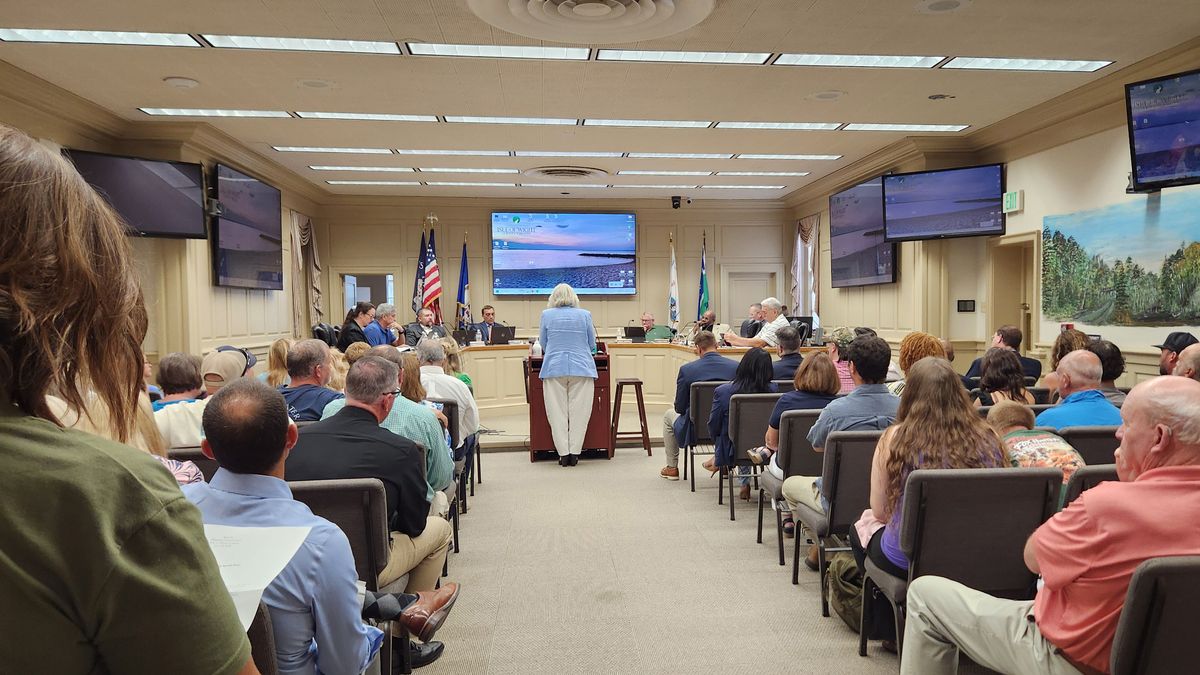
Isle of Wight County's Planning Commission postponed voting on a proposed Zuni mental health crisis center after a packed public hearing. A standing-room-only crowd turned out for a public hearing on a proposed mental health crisis center in Zuni at the July 28 Isle of Wight Planning Commission meeting. Stephen Faleski/The Smithfield TimesA public hearing on a proposed mental health crisis center in Zuni drew a standing-room-only crowd to Isle of Wight County’s Planning Commission meeting on July 28. Over 100 attendees filled the second-floor boardroom at the county government complex and spilled into the hallway as just over a dozen speakers, most opposed, spoke for over an hour. The Planning Commission voted unanimously to postpone its decision one month. The hearing concerned an application by the Western Tidewater Community Services Board to rezone 30 acres from rural agricultural conservation to rural residential on Yellow Hammer Road. The application also requests a conditional use permit to remove the existing agricultural subdivision restriction to establish the crisis center, which would be known as WTCSB Harvest Homes. Several area residents who spoke in opposition voiced concerns over the rural location’s distance from law enforcement, emergency medical services and Riverside Smithfield Hospital. Other concerns centered on “elopement,” or when someone in a mental health crisis wanders off. Zuni resident Katie Whisenant, citing a state Department of Behavioral and Health Development Services playbook for building crisis sites, noted the guidance states that facilities should be located in “non-residential” areas that are “close to a populated commercial location. ”“The proposed home would sit directly across from an established residential home and within a mile of approximately 25 others,” Whisenant said. Pamela Barton of Carrollton urged the community to support the project. “The crisis in Virginia for mental health is incredible, and people do not understand across the state you have children in foster care under the age of 18 that have disabilities, intellectual disabilities,” Barton said. There are very few resources for these children. Across the state they are having to spend days, nights at agencies because there is no crisis place. The state has closed multiple facilities. They’re not available. I completely understand ‘not in my backyard; I don’t want this by me,’ but at the same time, who is going to step up and help the situation?”According to the rezoning application, two group homes would be built on the currently vacant site, one for children ages 5-17 and the other for adults ages 18 and up. The two would share a driveway entrance off Yellow Hammer Road. Brandon Rogers, executive director of WTCSB, said each group home would be a “crisis therapeutic home,” which he defined as a six-bed licensed facility housing people with developmental disabilities for up to 30 days. Rogers said the facility wouldn’t admit anyone actively using illegal drugs or who is an “imminent threat to the health and safety of others. ”The Zuni site is intended to replace one in the city of Hampton the WTCSB has operated since 2017, he said. The homes would be staffed with three shifts per day, each requiring 20 to 30 employees. Each home would have an independent clinically trained staff and “we never have a ratio of less than one staff for every two clients,” Rogers said. Rogers said the WTCSB looked into locating the Isle of Wight site in Carrollton or Smithfield but chose Zuni after being unable to find a large enough site where development was not restricted by the presence of wetlands. The Zuni site would be surrounded by a 6-foot-tall fence and gate to deter elopement. “We follow an elopement plan for individuals that includes my staff staying with the individual, following them, going with them wherever they are going,” Rogers said. “We do contact law enforcement as a matter of protocol if they are to leave our site. ”Rogers said the adult crisis therapeutic home in Hampton saw 29 calls to law enforcement over the past calendar year, including two reported assaults, 15 mental health calls, three reports of suicidality and six calls for emergency custody or temporary detention orders. The former Zuni Presbyterian Homes, a similar facility that operated in the vicinity of the proposed site from 2005 to 2017, averaged 22 law enforcement calls per year, Rogers said. Harvest Homes would be modeled off of a similar facility in the Richmond metropolitan area. There are five adult crisis therapeutic homes in Virginia, including the one in Hampton that would relocate to Isle of Wight, Rogers said. There are also two children’s crisis therapeutic homes statewide, and the state Department of Behavioral Health and Developmental Services is “requesting that three more be built, including the one that we are proposing in Isle of Wight County. ”Rogers said the existing Hampton facility was originally operated by the Hampton-Newport News Community Services Board and, when that agency requested to step away from managing it, the state asked the WTCSB to take over. “It was never purpose-built,” Rogers said. “It was actually the combination of a guest home and a primary home. It has a terrible line of sight for the treatment that we provide. So you can’t see from one side of the home to the other. ”Rogers said the state provided funding to build a new facility at a location of the WTCSB’s choosing. “What we are not proposing is a crisis stabilization unit, which is a mental health treatment facility that’s a community-based diversion from hospital care for individuals with mental health conditions,” Rogers said. “We are not a crisis receiving center. A crisis receiving center is a 24-hour-a-day walk-in site where individuals can access care any time they need to. We operate one of those in Suffolk. ”It also would not be an “acute psychiatric unit,” which Rogers described as a hospital setting where individuals at imminent risk of danger to themselves or others are sent. The WTCSB was established in 1971 as the local public mental health authority serving nearly 6,000 individuals across Isle of Wight and Southampton counties and the cities of Suffolk and Franklin through nine group homes, three primary outpatient clinics, three existing crisis centers, three day-support programs and an 80-bed assisted living facility and school-based mental health staff, Rogers said. In Isle of Wight, Rogers said the WTCSB served nearly 800 individuals, both children and adults, in 2025. Additional public comments regarding the site will not be allowed when the Planning Commission reconvenes Aug. 25. The next opportunity for public input will be at the Board of Supervisors’ public hearing after the Planning Commission makes its recommendation to that body. Last year, the WTCSB purchased a house in the Colosse community in southern Isle of Wight to use as a group home. In that case, the existing house was already zoned residential and did not require a public hearing. Story TagsDon't miss the news!Sign up so you never miss a headline.