The Three Nevers: To Invade Taiwan, China Would Have to Make Military History Thrice
The amphibious invasion of Normandy on June 6, 1944, remains the largest and most complex amphibious operation in history. On the first day alone, Allied forces landed eight divisions,including five. . .
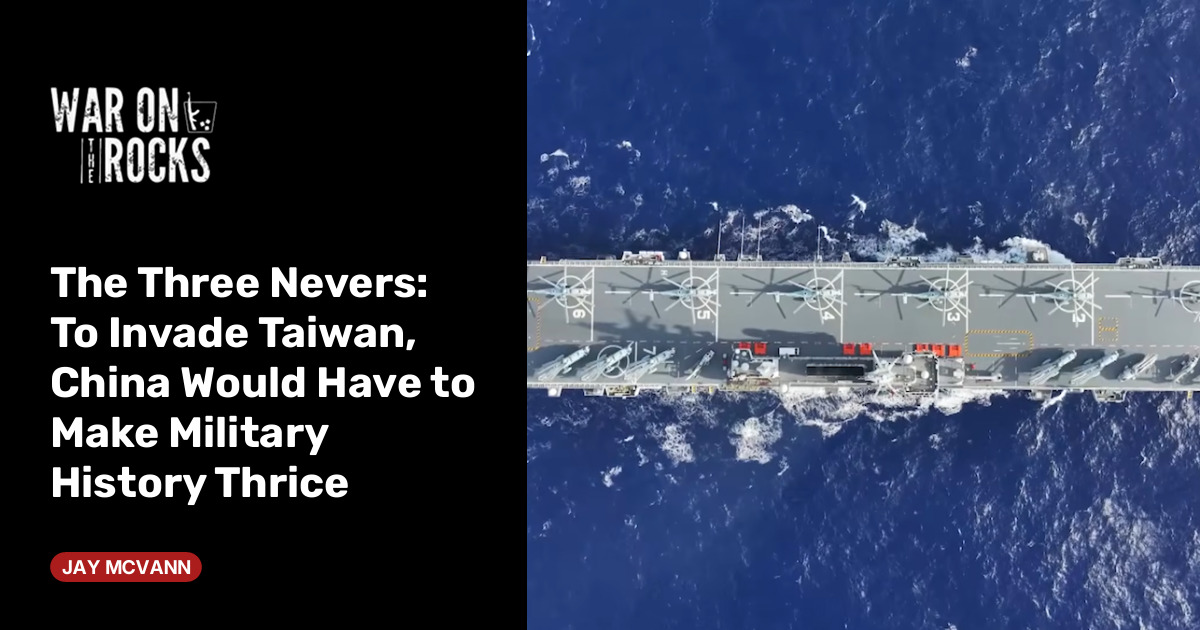
The amphibious invasion of Normandy on June 6, 1944, remains the largest and most complex amphibious operation in history. On the first day alone, Allied forces landed eight divisions,including five amphibious assaultandthree airborne, totaling roughly 160,000 personnel. That forcemore than doubledwithin days. Normandy was unprecedented in scale but not in kind. A Taiwan invasion would present the reverse problem: Taiwan’s size is not the unprecedented part — the operational challenges are. Analysis of a potential Chinese invasion of Taiwan typically emphasizes thePeople’s Liberation Army’s rapid modernizationand thepossibility of strategic surprise. Far less attention is paid to operational precedent. Three key missions at the heart of any cross-strait campaign have never been successfully executed under modern threat conditions: an amphibious landing against a credible coastal anti-ship missile threat, a large-scale airborne drop against modern air defenses, and a large, opposed air assault at extended range. In other words, the People’s Liberation Army would have to make history three times in the same campaign. I refer to these as the “Three Nevers,” a deliberately tongue-in-cheek nod toChinese Communist Party doctrinal formulations, ortifa. The absence of precedent does not prove impossibility. Major amphibious and airborne operations have been rare since World War II, especially in the missile age. Yet that rarity is analytically important. The familiar point is that invasion would be difficult. The sharper point is that Taiwan would not need to defeat the invasion force outright. It would only need enough surviving capability to disrupt the sequence. In a campaign built around tight timing and limited lift, the threshold for disruption is far lower than the threshold for destruction. China would have to move, land, reinforce, and sustain exposed forces under fire. Taiwan would only have to break that sequence. Lift makes the problem more concrete: China would need to deploy sufficient combat power ashore in the opening hours to prevent the beachhead’s isolation before follow-on forces arrive. That makes amphibious lift central to the campaign. If China cannot meet that threshold in the opening waves, it must either accept a dangerously thin landing force or compensate with airborne and air assault operations. Those workarounds create the second and third Nevers. None of this means an invasion is impossible. Political leaders may accept significant operational risk, and the People’s Liberation Army, as aparty army, will carry out the orders it receives. But the lack ofrelevant combat experience, from the lowest-ranking conscript to the(remaining) senior military leadershipof the Central Military Commission, makes these assumptions especially consequential. Why Lift Drives the Three NeversIn“Mind the Gap,”Thomas Shugart estimates that the People’s Liberation Army Navy can transport roughly 21,000 troops and the equipment of one heavy amphibious brigade per wave. Modified civilian roll-on/roll-off vessels could increase that to about three brigades. The number could rise further with access to ports and temporary causeways, but those would not be available to the first wave. An initial Chinese landing force of three brigades would be dangerously understrength against Taiwan’s ground forces. Taiwan’s army fieldsseven combined-arms brigadesand maintains20 reserve infantry brigadesto reinforce its active-duty units. Not all would be available at the landing site but given thelimited number of viable landing beaches, defenders would not need to be everywhere at once. Three brigades would remain well below thethree-to-one ratiooften associated with offensive operations. Because amphibious lift constrains tempo and mass, the People’s Liberation Army would rely onthree-dimensional operationsto compensate. The challenge is that airborne forces face modern air defenses while air assault forces must also operate at extreme range. Lift does not just drive the first Never. It creates the conditions for the second and third. Landing Under FireThere has never been an amphibious landing in the face of a coastal defense cruise missile threat. When the Allies came ashore at Normandy, the longest-range shore-based threats they faced were coastal artillery withrangesof up to roughly 15 miles. Taiwan’s coastal defense missiles can rangefrom 75to 93 miles, with extended-range variants reportedly reachingup to 250 miles. This means Chinese landing forces would be within range for most, if not all, of their transit across the strait. The approach to the beach becomes part of the fight. A Chinese campaign would almost certainly attempt to degrade these systems before the invasion. But suppression is not elimination. Much of Taiwan’s coastal defense cruise missile force ismobile, allowing it to exploit the island’s urban environment and mountainous terrain to avoid detection and engage Chinese forces with little warning. In a campaign this tightly sequenced, even a single surviving coastal missile battery could generate enough firepower to break a wave. The2006 Lebanon Waroffers a sobering illustration. Hizballah launched an anti-ship missile near Beirut,striking the Israeli Navy corvette INS Hanit. More recently, American forces have struggled to fully neutralizeHouthi anti-ship missile capabilitiesin Yemen, despite sustained strikes and persistent overhead surveillance. Taiwan’s coastal defenses are more capable, more mobile, and embedded in far more complex terrain, making them difficult to locate and engage. TheFalklands Conflictoffers another example. Argentina began the conflict with only five air-launched Exocet missiles. One struck HMS Sheffield, a modern air-defense destroyer, which later sank. Two more targeted the aircraft carrier HMS Hermes, but insteadhit the SS Atlantic Conveyor, a civilian merchant vessel. The ship sank three days later, taking several helicopters with it and significantly degrading subsequent land operations. The parallel to a Chinese invasion fleet is direct. Chinese landing forces wouldrely heavily oncivilian roll-on/roll-off vessels to transport combat power across the strait. As Mike Pietrucha argues, civilian vessels pressed into military service arepoorly suitedfor amphibious assault. Their design makes the problem difficult to engineer away: Large, open vehicle bays with few firebreaksbecome extraordinarily dangerouswhen loaded with fuel and ammunition. In April 2021, a fire aboard the modern Chinese roll-on/roll-off vesselZhong Hua Fu Qiangcaused significant damage in peacetime, without enemy action. A missile strike on a combat-loaded vessel would be catastrophic by comparison. Unlike the SS Atlantic Conveyor, losing a roll-on/roll-off vessel does not merely complicate the operation — it undermines an entire wave. A single vessel carries the personnel and equipment of nearly two battalions, and each hull lost is one fewer available to lift forces in subsequent waves. In a constrained lift environment, attrition is not linear, but compounding. Coastal defense cruise missiles are only one component of Taiwan’s defensive system. They are complemented bymines, naval- and air-launched anti-ship missiles, and agrowing inventoryof unmanned air, surface, and subsurface vehicles, all of which are cheaper and easier to produce than the vessels they would target. Taken together, these capabilities create a layered threat environment that further complicates any attempt to move, land, and sustain forces across the strait. Dropping Into Modern Air DefensesThere has never been a large-scale airborne drop against modern air defenses. On D-Day, Allied paratroopers faced anti-aircraft artillery and machine guns, not radar-guided missiles or modern shoulder-fired air defenses. Even so, theysuffered significant losses, and many drops were scattered. Reflecting on the losses suffered by Allied paratroopers during operations Overlord,Market Garden, andVarsity, military historian John Keegan writes inSix Armies in Normandy:Within a few years, when ground- and air-launched missiles would have been added to the troop-carrying aircraft’s enemies, no general anywhere would consider sending formations en masse against prepared positions, and the role of the parachutist would dwindle to that of the clandestine interloper. The problem Keegan identified has only grown more dire, yet People’s Liberation Army doctrine still relies on airborne assault in the opening phase of a Taiwan campaign. Its writings describe the integration of amphibious, airborne, and air assault forces as a “three-dimensional landing” operation intended to strike before the defender can mount an effective response. As outlined in the Science of Campaigns, airborne forces intend to seize key terrain, exploit confusion, and accelerate the tempo of the assault. Limited amphibious lift makes airborne forces not just a tactical enabler but a necessary means of adding combat power to the initial assault. The large transport aircraft that deliver paratroopers havelimited defensive capabilities and maneuverability. These aircraft mustfly low and slowalong similar routesas theyapproach the drop zone. Suitable drop zones are scarce in Taiwan’s complex terrain. Taiwan fields amodern integrated air defense systemthat includes early-warning radars, fighters, and surface-to-air missiles. Chinese strikes would aim to suppress these defenses before an airborne assault, but such efforts would not address the threat from mobile, man-portable systems. Taiwan operatesU. S. -supplied Stingerman-portable air defense missiles —infrared-guided systemsthat are extremely difficult to detect or suppress and are ideally suited to engage low, slow aircraft. Even a few dozen could inflict severe losses around Taiwan’s limited number of viable drop zones. The Tyranny of DistanceThe third Never is less a categorical first than an unprecedented combination of distance, exposure, opposition, and physics. The People’s Liberation Army would employ helicopter-borne air assault forces for the same reason it would employ paratroopers: Limited amphibious liftleaves gapsin combat power that only vertical insertion can fill quickly enough to matter. Like airborne forces, air assault forces depend onmultiple low, slow aircraftand a finite number of suitable landing zones. They face another challenge: range. Air assault forces launching from China would need to fly at least 100 miles to reach their landing zones. Although within theferry range of several Chinese helicopters, a realistic combat scenario — with loaded aircraft, low-altitude ingress to avoid air defenses, and time spent loading and unloading — would make the mission far more demanding. This is the third Never: a large, opposed air assault at extended range. The issue is not whether helicopters can fly that far. It is whether combat-loaded helicopters can do so at scale, at low altitude, against a prepared defender, and still deliver enough force to matter. The closest historical comparison is the2001 Marine air assaultinto Forward Operating Base Rhino in Afghanistan, but Navy special operations forces werealready on the ground, making it effectively unopposed. Those helicopters also relied on in-flight refueling,a capability China lacksfor rotary-wing aircraft. China could mitigate the range problem by launching air assault forces from its Yushen-class (Type 075) amphibious assault ships. Recent analysis from theJamestown Foundationsuggests that China intends to employ its amphibious assault ships in a counter-intervention role rather than in direct support of landing operations. If so, the force most capable of addressing that problem would be held back from the operation where it would matter most. ConclusionA Chinese invasion of Taiwan would not hinge on a single capability. It would require the People’s Liberation Army to execute several complex operations simultaneously, none of which has a historical precedent. Analysts often examine these three challenges in isolation, but they are interconnected. The same lift constraints that limit amphibious capacity also drive reliance on airborne and air assault forces, which are vulnerable in contested airspace and at extreme range. These are not independent challenges. They stem from the same underlying problem: the need to generate sufficient combat power ashore before Taiwan can isolate and defeat the landing force. A single survivingTaiwanese battery— four mobile launchers, four missiles each — could fire a volley of 16 Hsiung Feng III missiles, asmall fraction of Taiwan’s anti-ship missile inventory. An amphibious transport within 24 miles of the beach would have less than a minute between launch and impact. The disruption threshold is far lower than the destruction threshold: that battery need not sink the invasion fleet, only enough critical lift to break the wave. Losing a single roll-on/roll-off vessel removes the equipment of nearly two battalions from a force already thin against Taiwan’s ground forces. That loss increases pressure on airborne and air assault forces to compensate, even as those forces face their own threats from surface-to-air missiles, including man-portable Stingers. Failure in one part of the sequence worsens the others. The window for success is narrow, and each of the Three Nevers narrows it further. None of this makes an invasion impossible. Political leaders may accept significant operational risk to pursue strategic objectives, and the People’s Liberation Army is ultimately a party army that will carry out the orders it receives. Russia’s February 2022 invasion of Ukraine, launched despite amilitary that was unpreparedby almost every measure, is a recent reminder. While the People’s Liberation Army faces many challenges outlined above, so do Taiwan’s forces. They share a lack of recent combat experience. Under sustained attack, their forces would face problems with survivability, command, targeting, logistics, and morale. But the argument does not require Taiwan’s defenses to work perfectly. It requires only that enough survive to disrupt China’s landing operations. Taiwan and its partners should invest in exactly the capabilities that make each of the Three Nevers more costly: more coastal defense missiles and better low-altitude air defenses. These are the direct answer to the operational problem the Three Nevers describe. The best deterrent is not confidence that China will never try. It is Beijing’s doubt that any attempt would succeed. Jay “McFly” McVann is a U. S. Navy officer serving as the Navy Senior Service Advisor and China Program Director at the National Intelligence University. He has more than two decades of experience in naval intelligence and is a former TOPGUN instructor. The opinions and views expressed here are those of the author alone and do not necessarily represent those of the National Intelligence University, the U. S. Navy, the Department of Defense, or any part of the U. S. government. Image: China News Service viaWikimedia Commons