The W-Cube satellite, equipped with VTT's cutting-edge technology, concludes its four-year successful mission in Earth’s orbit
The W-Cube nanosatellite, made in Finland and ordered by the European Space Agency ESA, is currently descending towards the atmosphere at the end of its successful mission. Along with the satellite, its VTT-made radio beacon system will also ignite and burn to dust. The mission demonstrated for the first time ever that the extremely high and fast 75 GHz frequency band can be used in future telecommunications satellites.
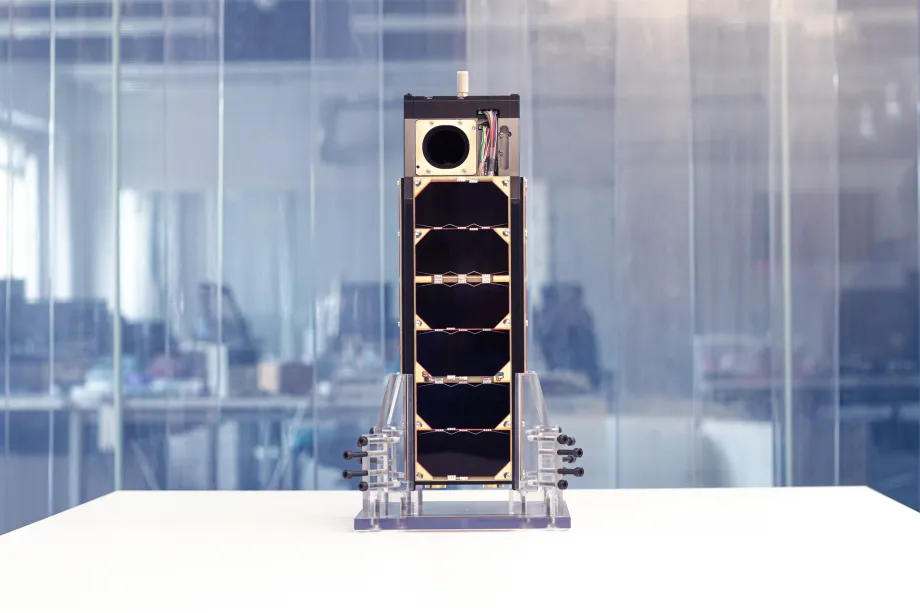
W-Cube was the firstsatellite ordered from Finland by the European Space Agency (ESA). The satellite—only slightly larger than a one-and-a-half-litre milk carton—was launched into orbit on 30 June 2021. It transmitted the radio signals essential in the mission using a radio beacon system developed by VTT Technical Research Centre of Finland and the German Fraunhofer IAF. The reliably functioning satellite platform of theFinnish company Kuva Spacealso played an important role. It consists of a frame, an attitude control system and solar panels, among other things. From its own ground station, the company was also responsible for operations. "Thanks to our experience with W-Cube, we have developed our systems so that satellite operations are fully automated. We have now launched five nanosatellites and achieved a 100% success rate that many others have not been able to match," saysJanne Kuhno, Chief Engineer and founding partner of Kuva Space. For Finland, the value of the W-Cube basic project was approximately one million euros, of which VTT's share was about half. VTT built and tested the payload and mechanics, such as the control electronics, frequency synthesizer and antennas. The purpose of the W-Cube satellite was to find out how much the Earth's atmosphere and its phenomena, especially raindrops and rain clouds, attenuate a very high-frequency radio signal. No previous experience of this existed. Signal reception was successful at ground stations in Finland, Austria and the Netherlands. "At our own satellite ground station in Otaniemi, we have been able to receive the signal until the very last few days. Based on long-term measurements carried out in different climate conditions, we have been able to create attenuation models that are absolutely essential when designing and dimensioning future high-speed telecommunications satellites," Säily says. The W-Cube's four-year operating time is a good achievement for its size class. Nanosatellites have a maximum lifespan of five to six years.