What Happens to Your Business Without a CRM? | Reality Check
Every small business owner has, at some point, run sales off a spreadsheet, a stack of sticky notes, or memory alone. It works, until it doesn’t. What happens to your business when you don’t have a CRM is. . .
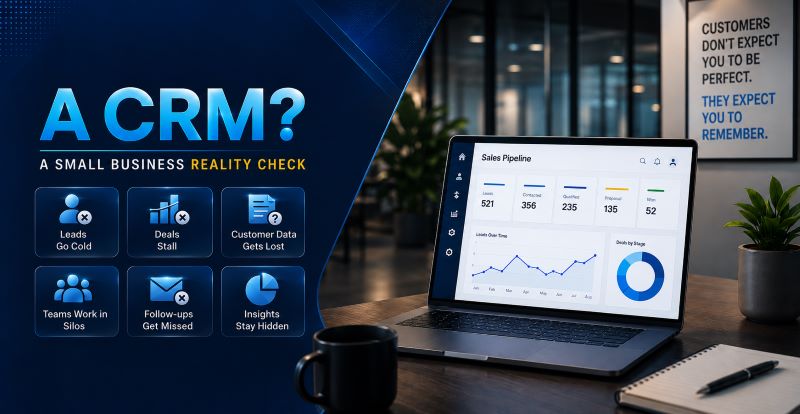
Every small business owner has, at some point, run sales off a spreadsheet, a stack of sticky notes, or memory alone. It works, until it doesn’t. What happens to your business when you don’t have a CRM is rarely dramatic on day one. It’s a slow leak: a lead that never gets a follow-up call, a client who feels forgotten, a deal that stalls because nobody remembers where it stood. This is the small-business reality check most owners eventually face: the point where “we’ve always done it this way” starts costing real revenue. Here’s what actually happens, backed by current data, and what it takes to fix it. What Actually Happens When a Small Business Skips a CRM?Without a central system, customer information lives in inboxes, phones, and someone’s head. That arrangement holds up for a handful of clients. It breaks the moment a business starts to grow. This is where the gap between having asmall business CRM solutionand running without one becomes visible in the numbers, not just the workflow. Leads go cold because no one owns the follow-upDeals stall in “someone will get to it” limboCustomer history disappears the moment an employee leavesTeams duplicate work because nobody sees the full pictureMarketing and sales run off separate data, so campaigns miss the markThis isn’t a fringe problem anymore. 91% of companies with 10 or more employeesnow run on a CRM system, and94% of tech companies and 71% of small businessesalready rely on one to manage customer relationships, according to2026 CRM adoption data. Businesses operating without one are now the exception, not the norm. The Real Cost of Running a Small Business Without a CRM1. The financial case is not abstract. Businesses that adoptCRM software for a small businessplatform see an average return of$8. 71 for every $1 spent, and CRM-driven follow-up and segmentation can lift conversion rates by as much as300%, perSalesmate’s 2026 CRM statistics. Separate research fromNutshell and Wave Connectshows CRM adoption correlates with a 29% increase in sales revenue and makes companies 86% more likely to exceed their sales goals. Run the math on your own pipeline: those are the deals, renewals, and referrals a business without a CRM is quietly leaving on the table every quarter. 2. Spreadsheets and Manual Systems Break Down?Spreadsheets don’t fail because they’re poorly built. They fail because they can’t scale with a growing customer base. Sales reps already lose over an hour a day to manual data entry, and 48% of businesses say fragmented data prevents them from delivering a consistent customer experience, according toSuperOffice’s 2026 CRM benchmark. A separate breakdown of thetrue cost of not having a CRMpoints to the same pattern: missed follow-ups, untracked conversations, and wasted marketing spend, all symptoms of managing leads by memory instead of a system. 3. The Hidden Cost of Poor Customer ServiceBad or scattered customer data isn’t just an inconvenience; it’s a cost center. Enterprise research from Gartner, cited bySuperOffice, puts the average cost of poor data quality at close to $12. 9 million a year for large organizations. Small businesses don’t operate at that scale, but the mechanism is identical: every duplicate contact, missed note, and outdated phone number adds hours of rework and, eventually, lost customers. Asmall business customer management softwaresystem exists specifically to close that gap by keeping one accurate record per customer instead of five conflicting ones. 4. Does Missing a CRM Affect Customer Retention and Trust?Retention is where the absence of a CRM hurts most quietly. Customers don’t complain when they’re forgotten; they just don’t come back. Businesses using a connected CRM platform report up to a27% improvement in customer retentionand as much as a 30% increase when sales, marketing, and service run on the same system, perSuperOffice’s platform data. Today’s customers expect a seamless, remembered experience across every channel. Businesses relying on manual tracking can’t consistently deliver that, and anaffordable CRM for smallbusinesses is often the fastest way to close that trust gap without a major budget commitment. How ConvergeHub Closes the GapThis is exactly the gap ConvergeHub was built to close. As an all-in-one CRM for small businesses, ConvergeHub unifies sales, marketing, service, and billing into a single connected system, so no lead goes cold, no customer history disappears, and no team works off outdated data. Instead of stitching together spreadsheets, sticky notes, and separate tools, ConvergeHub gives small businesses:One shared customer record— every call, email, quote, and note lives in a single profile, visible to the whole teamAutomated follow-ups— leads and deals get reminders and next steps triggered automatically, so nothing sits untouchedBuilt-in pipeline visibility— see exactly where every deal stands without chasing updates across spreadsheets or inboxesConnected sales, marketing, and service— campaigns, support tickets, and sales activity all draw from the same data instead of three disconnected tools. Reporting without the manual rollup— performance and forecast numbers update in real time instead of being rebuilt every weekNo enterprise price tag or rollout— priced and built for small business budgets and teams, with setup measured in days, not monthsStart a free trial or book a demo to see it against your own pipeline. The Bottom LineWhat happens to your business when you don’t have a CRM isn’t a single event;t, it’s a slow accumulation of missed follow-ups, lost data, and customers who quietly walk away. The small business reality check is simple: the businesses pulling ahead in 2026 aren’t necessarily working harder; they’re working with better systems. Fixing that doesn’t require an enterprise budget or a long rollout. It requires one connected place to manage every relationship, starting now. Frequently Asked QuestionsWhat happens if a small business doesn’t use a CRM?Leads and follow-ups get tracked inconsistently, customer history lives in individual inboxes instead of a shared system, and deals slip through the cracks as the business grows. Over time, this shows up as slower response times, missed renewals, and lower customer retention compared to businesses running on a connected CRM. How much money can a business lose without a CRM?It varies by business, but the data points to a real gap. Companies using a CRM see returns of roughly $8. 71 for every $1 spent and conversion rate increases of up to 300%, meaning businesses without one are likely losing a comparable share of revenue to missed follow-ups and disorganized pipelines. Is a CRM only useful for large companies?No. Modern CRM platforms are built specifically for small teams that need to track leads, automate follow-ups, and manage customer relationships without hiring a dedicated operations team. Most small business CRM plans are priced and structured for exactly this scale. What’s the real difference between a spreadsheet and a CRM?A spreadsheet stores data. A CRM manages relationships. It automates follow-ups, flags stalled deals, keeps one accurate customer record instead of several outdated copies, and gives every team member the same real-time view of where a customer stands. How affordable is CRM software for small businesses today?CRM pricing has become far more accessible than it was a few years ago, with plans built specifically for small business budgets and no long-term contracts required. Most platforms, including ConvergeHub, offer a free trial so a business can test the fit before committing.