When the Remedy Becomes the Crime: Affirmative Action, White Supremacy, and the New Politics of “Neutrality” - Greater Diversity News
By Peter Grear, with AI assistance July 22, 2026 Affirmative action did not emerge because America suddenly decided to provide special advantages to Black people. It emerged because the country
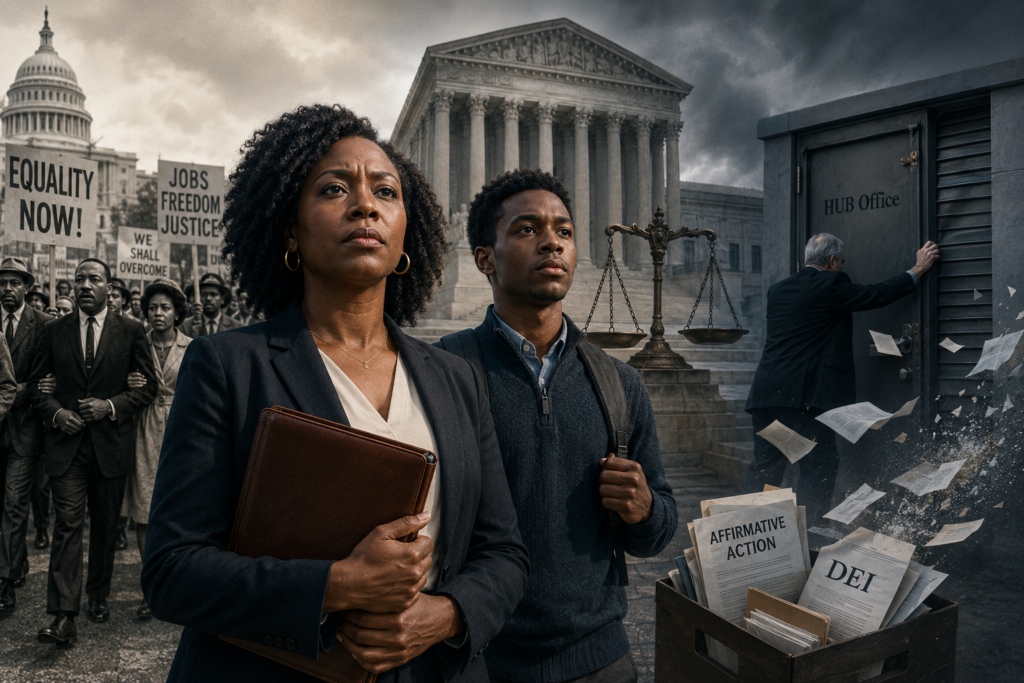
, with AI assistanceJuly 22, 2026Affirmative action did not emerge because America suddenly decided to provide special advantages to Black people. It emerged because the country was forced to confront a deeper truth: ending legal discrimination would not automatically erase the economic, educational, and institutional consequences of centuries of white supremacy. The Civil Rights Movement challenged laws that openly excluded Black Americans from schools, jobs, neighborhoods, voting booths, businesses, and public institutions. The Civil Rights Act of 1964 and related legislation outlawed many of the most visible forms of discrimination. But civil rights leaders understood that removing discriminatory language from the law was only the beginning. A society could end segregation on paper while leaving intact the wealth, networks, institutions, and economic relationships created under segregation. Employers could promise equal treatment while continuing to recruit from the same white professional circles. Universities could open their doors while relying on admissions standards shaped by unequal schools and inherited privilege. Governments could claim fairness in contracting while continuing to award public money through systems in which Black businesses had historically been excluded. Affirmative action represented an acknowledgment that equality required more than the absence of racial slurs, segregated facilities, or openly discriminatory rules. It required institutions to take deliberate steps to identify exclusion, expand access, measure participation, and correct unequal outcomes. That is why affirmative action must be understood as a limited challenge to white supremacy. White supremacy is not only an expression of individual hatred. It is also a system through which power, wealth, opportunity, and institutional access have historically been distributed. Under that definition, affirmative action sought to interrupt the continuing operation of a system that had long treated white advantage as normal and Black exclusion as natural. The current rollback of affirmative action and diversity, equity, and inclusion policies represents a major change in how government defines equality. The older civil rights framework asked whether institutions were continuing to reproduce exclusion. The newer framework increasingly asks whether institutions are treating everyone the same in the present moment, regardless of how unequal the starting conditions may be. This shift is often described as colorblindness. Colorblindness sounds fair because it promises that race will no longer matter. But in practice, it can require government to ignore the very racial history that created today’s inequalities. When race-conscious remedies are removed while existing disparities remain, the old distribution of power does not disappear. It is protected by the language of neutrality. That is the central problem. A race-neutral system is not necessarily a fair system when it operates on top of wealth gaps, unequal schools, restricted access to capital, inherited business relationships, and contracting networks built during periods of formal discrimination. Under these conditions, “neutral competition” can become a way of preserving advantages that were never created neutrally. This is why the elimination of North Carolina’s Historically Underutilized Businesses Office carries meaning beyond the closure of a government agency. The HUB Office represented the idea that the state had a responsibility to examine who received public contracts, identify businesses that had been historically excluded, and create pathways for broader participation. Its work recognized that government procurement does not take place in a historical vacuum. Abolishing the office signals a different philosophy. It suggests that government should no longer organize policy around racial exclusion, even when racial disparities remain. It shifts attention away from history, measurable outcomes, and institutional responsibility. It replaces the question, “Who has been denied access?” with the narrower question, “Are the rules written the same for everyone?”That shift does not require lawmakers to openly support racial discrimination. It does not mean every person who opposes affirmative action is personally committed to white supremacy. The more important question is what the policy does. Does it remove tools that were created to measure exclusion? Does it weaken accountability? Does it make it more difficult to identify who receives public resources? Does it leave historically advantaged networks intact while eliminating the mechanisms designed to broaden access?If the answer is yes, then white supremacy is implicated through outcomes, institutional structure, and the preservation of inherited advantage, even when explicitly racist language is absent. This is the new form of racial retrenchment. The older system defended white supremacy through segregation and exclusion. The newer system can defend racial hierarchy through formal neutrality, institutional withdrawal, and the refusal to acknowledge history. The most important change is not simply that affirmative action programs are being eliminated. It is that the moral meaning of civil rights is being reversed. During the Civil Rights era, racial inequality was treated as evidence that government had failed to do enough. Today, efforts to address racial inequality are increasingly portrayed as the injustice. The remedy has become the crime. Affirmative action emerged from the recognition that white supremacy had shaped American institutions too deeply to be corrected by neutral language alone. Its rollback marks a return to a system in which government may prohibit explicit discrimination while refusing to examine the racial hierarchy that remains. The challenge now is to build new institutions, new accountability systems, and new forms of collective economic power that do not depend entirely on government’s willingness to remember what history created. The struggle is no longer only to defend affirmative action. It is to prevent neutrality from becoming the language through which inequality is permanently protected.