2026 Isn’t the First Time Christians Have Tried to Claim the United States as Their Own
President Reagan, Nancy Reagan and Billy Graham at the National Prayer Breakfast held at the Washington Hilton Hotel. White House Photographic Office. David Mislin,Temple UniversityAmid celebrations of. . .
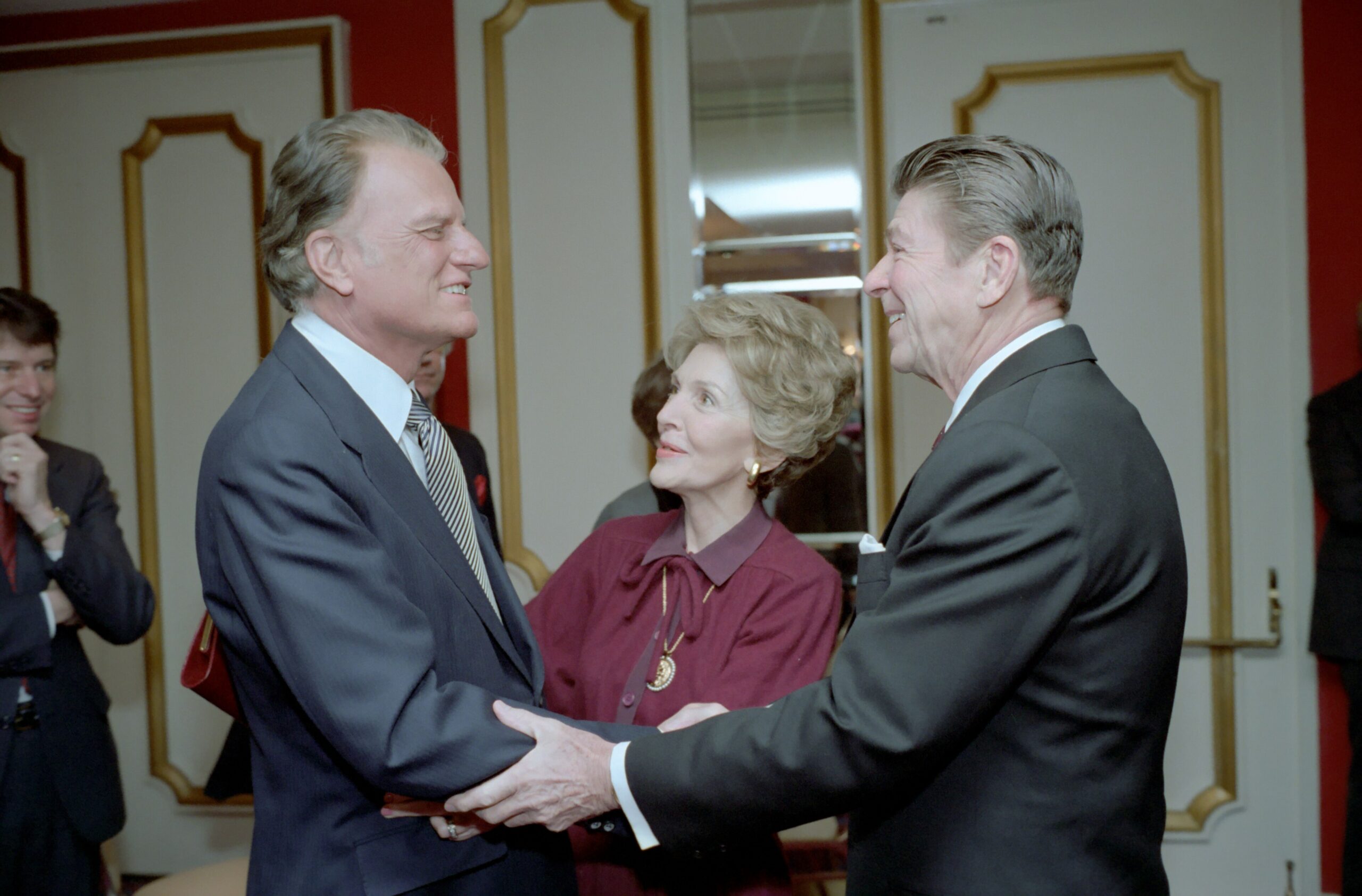
President Reagan, Nancy Reagan and Billy Graham at the National Prayer Breakfast held at the Washington Hilton Hotel. White House Photographic Office. David Mislin,Temple UniversityAmid celebrations of America’s 250th anniversary, assertions of the country’s religious, and specifically Christian, character have grown louder in political discourse. In May 2026, House Speaker Mike Johnson and other prominent officials participated in aprayer servicein Washington, D. C. Johnson proclaimed, “We hereby rededicate the United States of America as one nation under God. ” Thoughplanners invokedthe nation’s “Judeo-Christian” heritage, most religious leaders at the event came from the evangelical Christian tradition. In a prerecorded video,President Donald Trump readfrom the New Testament book of 2 Corinthians. Many ordinary Americans who attended the prayer service seemed to recognize the desire to link the United States with Christianity. One told a reporterthat the U. S. was “founded on a Christian doctrine,” whileanother insistedit was “an important thing for our nation, just to put Christ back first. ”These ideas weren’t limited to this one-time gathering. In speeches and prayers at public events, Secretary of DefensePete Hegsethproclaimedthe U. S. to be “one nation under God. ” In February 2026, at a Christian broadcasters convention,he declaredthat “Christ is King” and claimed “a direct through line from the Old and New Testament Christian gospels to the development of Western civilization and the United States of America. ”At first glance, these expressions might seem triumphalist declarations that link the nation’s success over the past 250 years with Christian faith. As ahistorian of U. S. Christianity, however, I recognize expressions like these often arise when Christian Americans are feeling anything but triumphant. Civil war and committing to GodAs the U. S. plunged into Civil War in 1861, both the Union and Confederacy sought to link their side to God. Thepreamble of the Confederateconstitution noteda desire for “the favor and guidance of Almighty God” for their new government. In the North, the Pennsylvania clergyman M. R. Watkinson successfully lobbied for a reference to God to be added to coins. Watkinson believedthe nation was guilty of “disowning God” andurged the treasury secretaryto make declarations of religiosity. This would “place us openly under the divine protection,” he noted. Three years later, as war dragged on, a group comprising members of the North’s major Protestant denominations urged a change to the preamble of the U. S. Constitution. Its memberssought to declarethat Americans recognized “Almighty God as the source of all authority and power in civil government” and desired “to constitute a Christian government. ”The amendment was not ratified during the Civil War, but the efforts in both the North and South revealed how an existential political crisis pushed language of God into government. Efforts to declare America ChristianSoon after the Civil War, Protestant Christians in the U. S. perceived anew threat. Beginning in the 1870s, atheism and indifference to religion became popular, especially among younger intellectuals. Rising numbers of Catholic and Jewish immigrants brought greater religious diversity. Fearing a loss of their significantclout and influence, devout Protestants revived the earlier campaign to write their faith commitments into the Constitution. In addition to placing references to God and Jesus in the Constitution, theirproposed amendment declaredthe Bible “the supreme rule for the conduct of nations. ”This was at odds with the beliefs of Roman Catholics, who look to church teaching and tradition along with the Bibleas sources of religious authority. The strong emphasis on the Bible made clear that the amendment was written primarily for Protestants. Supporters of the amendment includedWilliam Strong, a justice on the Supreme Court. In 1873,Strong suggestedthat the Constitution must either be made “explicitly Christian” or else Christianity would be “obliterated” from every U. S. institution. The Christian amendment ultimately failed, largely becausenot all Protestantssupported it. But anxieties about growing diversity and rising indifference had convinced many Americans of the need to enshrine Christianity in the Constitution. A godly nation with Cold War anxietiesAnxieties in the aftermath of World War II and the dawn of the Cold War brought another rise of Christian rhetoric in U. S. civic life. In 1954, President Dwight Eisenhower signed a bill adding the phrase “under God” to the Pledge of Allegiance. Thepresident’s signing statement notedthat the phrase represented a “reaffirming” of “the transcendence of religious faith in America’s heritage and future. ” This was important given the “violence and brutality” the world had experienced and the worrying “prospect of atomic war,” it said. President Eisenhower at the New York Avenue Presbyterian Church on Feb. 7, 1954, when he amended the Pledge of Allegiance to include the words ‘under God. ’Hilltoppers via WikimediaThe following year, Eisenhower signed a bill placing the phrase “In God We Trust” on all American currency. One of the bill’s sponsors, U. S. Rep. Charles Bennett, a Florida Democrat, invoked the now-familiar idea of the nation’s religious character. Bennett insistedthat the U. S. “was founded in a spiritual atmosphere and with a firm trust in God. ”These developments stemmed from the goal of strengthening Americans’ religious commitment amid the conflict and competition of the early Cold War. Scholars have demonstratedthat political leaders like Eisenhower and religious figures, such as the increasingly popular evangelist Billy Graham, all stressed the importance of strong religious faith. In their eyes, that faith set the U. S. apart from the “godlessness” of Soviet communism. The historianKevin M. Krusehas shownthat the rise of religious language reflected domestic political concerns as well. President Franklin D. Roosevelt’sNew Deal programs, designed to respond to the Great Depression, had expanded the federal government’s role in the economy and empowered organized labor. An alliance of conservative business leaders and ministers feared a loss of influence in this new political and social reality. During the 1950s they linked their values “faith, freedom, and free enterprise,”Kruse writes, all under the ideal of the U. S. as a nation under God. 250 years of faith and fearMore often than not, the insistence that the U. S. is “one nation under God” is not a triumphant statement of success. This fear was evident in the response of an attendee at the “Rededicate 250” prayer service in May. Wheninterviewed by PBS, this attendee declared, “American is built on the Christian faith,” and added, “if we lose this faith, the whole country will collapse. ”Throughout the nation’s history, that existential fear has inspired efforts to declare the U. S. a Christian nation. This article is republished fromThe Conversationunder a Creative Commons license. Read theoriginal article. David Mislin is Assistant Professor of Intellectual Heritage at Temple University.