America’s Middle East Bases: An Imperial Burden
By all conventional measures, America is losing the war with Iran. The Iranian Revolutionary Guard Corps (IRGC) has survived the U. S. -Israeli regime change effort, and it seems as though the hardline
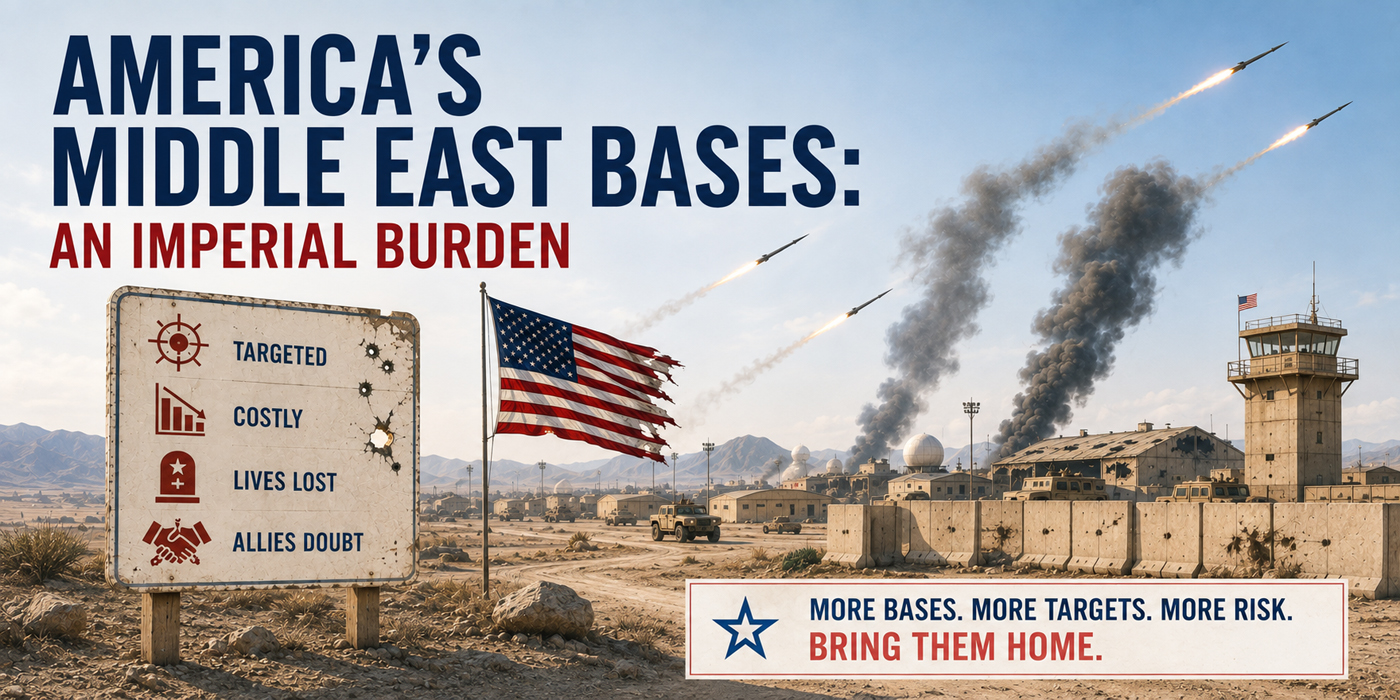
, America is losing the war with Iran. The Iranian Revolutionary Guard Corps (IRGC) has survived the U. S. -Israeli regime change effort, and it seems as though the hardline factions in Iran have beenempowered. They also maintain their stockpiles ofdrones and missiles, while the U. S. is runningdangerously lowon crucial munitions. Perhaps the most tangible sign of strategic defeat for the U. S. comes in the form of destroyed bases. Throughout the conflict, Iran has dealt severe blows to U. S. bases across the region, resulting in18 troopshaving been killed andover 600sustaining injuries. A predictable outcomeIran’s ability to touch American bases across the Middle East was not surprising to many of those advocating against this war. In fact, it was one of the foremost reasons to show restraint. In August 2025, Dr. Trita Parsi, executive vice president of the Quincy Institute for Responsible Statecraft,warnedthat in the case of a renewed conflict, Iran would likely act with much less restraint than they did during the 12-day War. “It’s not going to be like last time,” Dr. Parsi explained, “the Iranians may this time around strike at U. S. bases in a manner that they didn’t last time. Last time, as one Pentagon official said, it was a polite response because it was all about ending the war. This time around, it’s likely going to be much worse. ”Dr. Parsi also expressed concern about American defensive systems, saying “we know now that the Iranians have missile capabilities that can penetrate all layers of Israeli and American air defense systems and can lead to a large number of American deaths. So we will once again have Americans coming home from the Middle East in coffins. ”Tragically, these predictions have proven entirely correct. From the early days of this war, the damage became apparent. The New York Timesreportedin late March that many American bases in the region had been rendered “all but uninhabitable. ” The Iranians attacks have been effective at knocking out keydefensiveandcommunicationsinfrastructure as well. All of this information has been intentionally underdiscussed by the Trump administration, in the hopes that Americans will buy their narrative that an easy U. S. victory has occurred. Despite their decision to not inform the public of this troubling data, the risks are very real for troops still positioned in the region. Since the collapse of theMemorandum of Understanding,four U. S. soldiershave been killed, androughly 100have been injured by Iranian attacks. Many of America’s bases in the Middle East simply weren’t prepared to face Iranian retaliation at the scale we’ve witnessed. During the wars in Iraq and Afghanistan, the fighting occurred predominantly within the borders of the respective countries, so many U. S. military facilitiesweren’t designed to withstand extensive enemy fire. Iran, however, is a much different story. As Dr. Parsi warned in August, Iran possesses both the willingness and the capability to inflict severe harm on U. S. military infrastructure across the region. They have used their arsenal of short and mid-rangeballistic missilesto deal major blows tobasesin Kuwait, Bahrain, Jordan, and Iraq since the beginning of July, after the MoU fell apart. Given these undeniable facts, Trump’sclaimfrom early in the war that we had “destroyed 100% of Iran’s Military capability,” makes even less sense. This delusional notion – that the U. S. has “won” the war – has been acommon sentimentfrom the President. He seems to be in his own fantasy land when it comes to this war, as the troops pay the ultimate price for his reckless decisions. While Trump repeatedly fails to grasp the seriousness of the situation, American bases are becoming more vulnerable. NBC News recentlyreportedthat in an effort to preserve the quickly-depleting supply of defensive systems, U. S. military commanders have begun allowing Iran to hit certain American targets. Not only does this report further prove that U. S. stockpiles of key missile interceptors arerapidly shrinking, but it also reveals the increased risk posed to U. S. troops. To put it simply, U. S. bases do not have the weapons or infrastructure needed to defend against extensive attacks during a prolonged conflict with Iran. Ignoring the warningsFor years, the Pentagon has warned presidents about this dynamic. In 2007, Vice President Dick Cheney sought to convince President George W. Bush to bomb Iran. The Pentagonwarned againstCheney’s proposal, saying that Iran would have “escalation dominance” over the United States in the event of a military conflict. This meant that Iran had more ways to threaten U. S. interests in the region than the U. S. had to threaten Iran’s, allowing Iran to control the intensity of the conflict and the pace at which it would escalate. We have seen this play out precisely over the course of this war. While the U. S. has engaged in these aimless on-again, off-again strikes, which have done little to achieve our objectives or degrade the Iranian’s will to fight, Iran has harmed the U. S. in a variety of serious ways. Economically, the closure of the Strait of Hormuz has caused a squeeze on the global oil supply, hurting Americans financially. This also poses a political issue for Trump and the Republicans, who are now forced to answer for high gas prices nationwide. The U. S. Strategic Petroleum Reserve is also at itslowest level since the 1980s, worrying industry experts. Iran’s network of proxies have also helped them expand the conflict, particularly in Yemen. Ansar Allah, also known as the Houthis, hasbegun threatening shippingin the Bab-el-Mandeb Strait. This has cut Saudi Arabia off from a key waterway they have used toreroute oilthat they have been unable to export via the Strait of Hormuz. Because of this escalation, the global economy is feeling additional strain, increasing pressure on Trump. Militarily, as I stated before, U. S. bases across the region have been critically damaged, to the point where the militarymay not returnto them. Meanwhile, Iran is expanding their territorial influence byestablishing government agenciesto administer control of the Strait of Hormuz. Iran is being strengthened, while America’s regional presence is shrinking. These attacks have alsoexposed a flawin the old way of thinking about U. S. bases. It was previously believed that having a U. S. troop presence in your nation would serve as deterrence against attacks on your soil. However, this concept has proven faulty. For one, the never-ending American military presence in many of these countries has made it logistically easier, thus more tempting, for American presidents to launch military campaigns on a whim. Instability and uncertainty has been the result. Furthermore, rather than serve as a deterrent against hostilities, hosting U. S. soldiers on their soil has actually made the Gulf states more prone to attacks, and therefore less safe. This has gravely impacted their ventures into industries such astourism and finance, as the elites of the world likely won’t choose to reside in nations which are frequently bombed when they have the means to live elsewhere. All of these down-stream effects have led these allies of the United States to reconsider their relationships with Washington. The right move going forwardMost of our bases in the Middle East were not made for a war with a nation like Iran, with thecapability to inflict severe damage beyond their borders. They are relics of a fading imperial strategy. By failing to recognize this, Trump has put our troops in unnecessary danger. Many say that in order to honor the troops, we must “finish the job. ” Not only is this notion incredibly vague, but it is also incorrect. The best way to honor the troops is to make sure that not one more American soldier dies needlessly. That means ending this war and withdrawing from the Middle East. As the great Ron Paulwisely said, “We just marched in, we can just come home. ”Nolan Denaro is an independent political analyst, writer, and host of “The Quest For Clarity” podcast, which can be found onYouTubeandSpotify. His work has been featured onAntiwar. comandMises. org. He writes on U. S. foreign policy, economics, and current events, with a particular focus on war and imperialism. He writes opinion pieces on hisSubstack, and you can follow him on X@nolandenaro. Nolan can be reached for correspondence atnolansdenaro@icloud. com.