Michael Rattray & Robert Kiel: How Science Is Trying to Restore Santa Barbara’s Lost Kelp Forests
TheBeach Erosion Authority for Clean Oceans and Nourishment(BEACON) unanimously approved the next phase of theGoleta Bay Kelp Projecton July 17. This endorsement is a monumental step in validating the means. . .
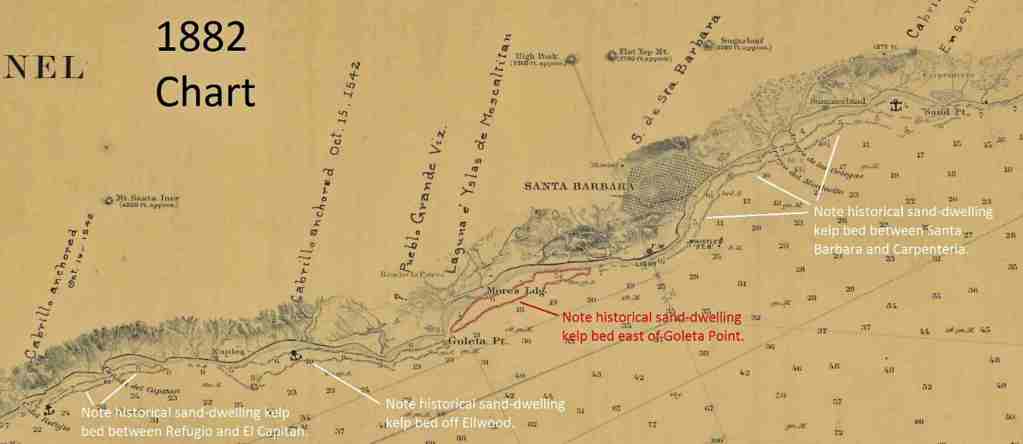
TheBeach Erosion Authority for Clean Oceans and Nourishment(BEACON) unanimously approved the next phase of theGoleta Bay Kelp Projecton July 17. This endorsement is a monumental step in validating the means and methods of this project’s objective of assisting mother nature in recruitment and growth of sand-dwelling kelp that has not advanced for decades. Giant kelp (Macrocystispyrifora) normally establishes on nearshore rock reefs within the region and other locations throughout the world. However, theSanta Barbara Channel’seast-west orientation and offshore islands provide protection against large swells, also enabling the kelp to recruit on worm tubes residing in the seafloor sediment and establish sand-entrained holdfasts capable of anchoring clusters of fronds to the seafloor. The immense size and density of the historic sand-dwelling kelp forests created the conditions that enabled them to flourish. Historically, there is documentation of the extent of these most unique kelp forests in the Santa Barbara region, which provided food and shelter for numerous coastal species and supported both our Chumash natives and immigrant settlers for subsistence. In the early 20th century, kelp harvesters routinely mowed the upper canopy for the raw materials most recently used to extract alginate, a suspending and gelling agent used in many products each of us use every day. However, the 1982-1983El Niñostorms changed Southern California forever with the power and destruction that was recorded as a 100-year event. “As for the state of California, the relentless storms caused by this El Niño are classified as the state’s No. 1 most extreme weather event by theWestern Regional Climate Center,” according to BEACON. “It caused more than $1. 2 billion in damage, destroyed nearly 8,000 homes and businesses, and triggered catastrophic coastal erosion and mudslides. ”Additionally, the sand-dwelling kelp forests were ravaged by episodically large swell events that dislodged most of the holdfasts. Loss of the forests’ size and density resulted in the eventual demise of remaining isolated kelp plants. Credit:Santa Barbara Historical Museum archivesA storm-damaged pier in Ventura County during the January 1983 El Niño. Kelp clumps blanket the beach near UC Santa Barbara during the 1983 El Niño storms. Credit:Art Sylvester photo / UCSB Geological SciencesOur team — Bob Kiel (retired chief engineer at theSeattle Aquarium), Greg Christman (an architect atAB Design Studio) and later this author — have been trying to determine root cause(s) for the inability of the kelp forests to recover naturally. Water parameters tend to be suitable for kelp, evident by continued kelp establishment on nearshore reefs within the region. However, juvenile kelp sparsely recruiting on worm tubes within the historic kelp forest footprint continue to be observed succumbing to dislodgement or grazing by herbivores. In 2015 we partnered with BEACON to initiate a pilot study to test if kelp would recruit and establish on granite columns embedded into the seafloor within a one-acre plot located inside the historic kelp forest footprint. Kelp initially recruited on the “clean” granite surfaces, but lacking the structure of an established forest, the growing fronds were often drawn down by wind-generated currents, preventing the necessary exposure to sunlight for optimizing photosynthesis. A juvenile two-spot octopus found residing within a dive snorkel found on the seafloor within the study site off Goleta. Understory algae and other encrusting organisms eventually colonized on the granite columns, dramatically reducing the ability forMacrocystiskelp to recruit. Grazers, such as kelp crabs (Pugettia producta) and various species of snails were routinely observed congregating on isolated juvenile kelp plants. Determining if an intervention exists to augment the natural recruitment and establishment of giant kelp on worm tubes remains the focus of the study. To address apparent imbalance within the ecosystem with regards to invertebrate grazers and their predators, we experimented with reconfiguring some of the granite columns by casting concrete chambers on top and re-embedding them to attract and provide refuge for two-spot octopus. Two inspectors flank a vitrified clay octo-cylinder, plugged with sulfate-resisting concrete and 2-inch hole cored into the upper sidewall. Credit:Rattray family photoThe large and complex sand-infused holdfasts of the historic kelp forests provided refuge for many marine species, including octopuses that are also prey to numerous species. Lacking suitable refuge for adult octopuses within the existing sand barrens, our team has been collaborating with scientists from theUC Santa Barbara Marine Science Instituteand others to refine the study’s next phase, which includes the embedment of “octo-cylinders” fabricated with vitrified clay pipes. Criteria for these current columns include scalability for covering vast acreage. They are fabricated from 100% natural materials that will conceivably last indefinitely in this application and be completely benign to the marine environment and future generations of people. Their relatively small individual footprint and large spacing also meet a keyCalifornia Coastal Actrequirement. Our statement of work outlined to the BEACON board is to test a novel means and method for installing the octo-cylinders with our selected marine contractor,Gravity Marine, which has the equipment and expertise for embedding them from a surface vessel. Upon validation of the embedment process through testing in the coming months, the next phase of the study will be to design test plots to be sized and configured based on continuing collaboration with independent scientific researchers to develop survey protocols and metrics to be measured for acquiring quantifiable empirical data. We want to thank the BEACON board and staff, theCounty of Santa Barbara, and the approval agencies at the state level for their continued support and encouragement on the success of this worthwhile project. Also, a special thanks to former Santa Barbara County SupervisorDas Williams, who originally secured the funds for the upcoming embedment tests when on the BEACON board.