Museum of Science and the Cosmos: From Sky to Thesis
Monthly Astronomy Talks Highlight Research from Young Scientists Starting on 23 July 2026, the Institute of Astrophysics of the Canary Islands (IAC) will host a series of monthly talks featuring PhD students as speakers. This initiative aims to showcase the work of emerging researchers in an engaging and accessible format, covering their current research topics […]
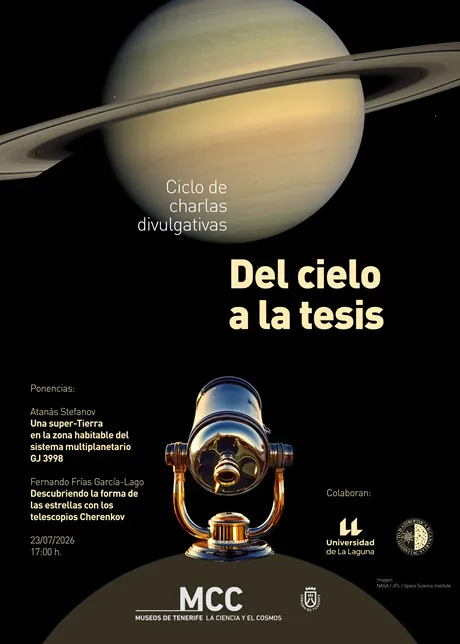
Monthly Astronomy Talks Highlight Research from Young ScientistsStarting on 23 July 2026, the Institute of Astrophysics of the Canary Islands (IAC) will host a series of monthly talks featuring PhD students as speakers. This initiative aims to showcase the work of emerging researchers in an engaging and accessible format, covering their current research topics as well as broader themes in astronomy and astrophysics. It will also delve into the practical applications of their findings, explaining the reasons behind their research efforts. Launched on 24 July 2025, this series is now celebrating its first anniversary, signifying its successful establishment and regular engagement with the public. Highlights of the Upcoming TalksA Super-Earth in the Habitable Zone of the GJ 3998 SystemResearch reveals that the low mass of red dwarf stars is promising for exoplanet discovery via radial velocity (RV) methods. However, stellar activity may obscure or mimic planetary signals. This talk will focus on GJ 3998, located 59 light-years away, which has two known super-Earths: GJ 3998 b and GJ 3998 c. Using additional data from the HARPS-N spectrograph, the speakers will confirm these planets and explore the potential for new detections. They will present a joint modelling approach of the RV signals, stellar rotation, and activity indicators, successfully confirming the two known planets and detecting a third: GJ 3998 d. This new find has an orbital period of 41. 7 days, a minimum mass of 6. 1 Earth masses, and a stellar flux comparable to Earth. Understanding Star Shapes with Cherenkov TelescopesThis talk will investigate the shape of stars, discussing historical advancements in precision observation techniques, including the pioneering work of Robert Hanbury Brown in the 1960s and the modern Cherenkov telescopes found in La Palma and Tenerife. These innovative telescopes have revitalised intensity interferometry, allowing researchers to measure star characteristics, distinguish binary systems, and achieve remarkable resolution through light fluctuations. SpeakersAtanás StefanovAtanás is a PhD candidate at the IAC, focusing on the detection of rocky exoplanets around cool dwarf stars. After graduating from University College London in 2023, he joined the IAC through the prestigious La Caixa INPhINIT fellowship. With a strong technical background in programming, Atanás aims to develop astrophysical tools applicable to various data sources. Fernando Frías García-LagoFernando is part of the first cohort to complete a dual degree in Physics and Mathematics at the University of Cantabria. He then pursued a Master’s in Theoretical Physics at the Complutense University in Madrid. He gained experience at CERN’s CMS collaboration and has since engaged in a PhD at the IAC. Currently, he works with the MAGIC, LST, and CTAO collaborations, focusing on gamma-ray sources and the application of intensity interferometry to analyse stars, while also contributing to instrumental developments for this technique.