Structure of Atom Class 9 Notes Advanced Science Chapter 6
Reviewing Class 9 Advanced Science Notes and Chapter 6 Structure of Atom Class 9 Notes regularly helps in retaining important facts. Structure of Atom Notes Class 9 Advanced Science Class 9 Structure of Atom Notes Discovery of Subatomic Particles In 1803, Dalton proposed that atoms are the smallest indivisible particles of matter. However, this idea […]
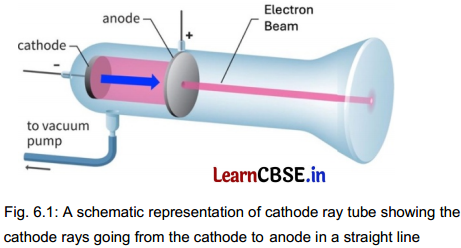
ReviewingClass 9 Advanced Science Notesand Chapter 6 Structure of Atom Class 9 Notes regularly helps in retaining important facts. Class 9 Structure of Atom NotesDiscovery of Subatomic ParticlesIn 1803, Dalton proposed that atoms are the smallest indivisible particles of matter. However, this idea failed when substances like glass or ebonite, on being rubbed with silk or fur, acquired an electric charge – showing that atoms can be broken down further. Experiments on electrical discharge through gases confirmed that atoms are made up of smaller particles called subatomic particles. The journey to understand the atom involved a series of models, each improving on the last. J. J. Thomson (1897) discovered the electron, proposed the plum-pudding model (electrons embedded in a sphere of positive charge). Rutherford disproved Thomson’s model via the gold foil experiment, proposed electrons revolve around a small, positively charged nucleus. Niels Bohr addressed the instability problem in Rutherford’s model with a new quantum-based model. In this chapter, we trace the discovery of three subatomic particles-the electron, proton and neutron. A fundamental principle to remember is “like charges repel, unlike charges attract”. Discovery of ElectronIn the late nineteenth century, scientists including Michael Faraday and William Crookes studied electrical discharge in partially evacuated glass tubes called cathode ray discharge tubes. J. J. Thomson extended these experiments using gases at low pressure, with two metal plates connected to opposite terminals of a battery. When sufficiently high voltage was applied-Rays were observed travelling from the cathode (negative electrode) toward the anode (positive electrode) called cathode rays. When these rays passed through a hole in the anode and struck a specially coated screen, a bright spot appeared, confirming straight-line travel. To determine the nature of these rays, Thomson applied electric and magnetic fields along their path. The rays deflected toward the positively charged plate, indicating they carry negative charge. Thomson concluded that cathode rays consist of tiny negatively charged particles, later named electrons. When the experiment was repeated with different gases (H2, N2, Ne, etc. ) and different electrode materials, the properties remained unchanged—confirming electrons are present in all atoms. → Key characteristics of cathode rays:They originate at the cathode and travel toward the anode. They are invisible but cause a bright spot when they strike certain materials. They travel in straight lines in the absence of external fields. They are deflected by both electric and magnetic fields in a manner consistent with negative charge. Their properties are independent of the nature of the gas or the electrode material. Discovery of ProtonOnce electrons were identified as negatively charged, it became clear that atoms must also contain a positive charge to remain electrically neutral. Eugen Goldstein (1886) investigated this using a modified discharge tube with a perforated (holed) cathode. → Key observations from Goldstein’s experiment:When high voltage was applied, a faint glow appeared behind the cathode. Rays responsible for this glow passed through the holes and these were called canal rays. Canal rays deflected toward the negatively charged plate, confirming they carry positive charge. Unlike cathode rays, canal rays are not identical their mass and properties depend on the gas used, since they are simply positive ions of the gas present in the tube. When hydrogen gas was used, the lightest positive particles were obtained which were identified as hydrogen ions (H+) and later recognised as protons. Rutherford formally established the proton as a fundamental particle in 1919. → Key characteristics of canal raysThey carry a positive charge. Their behaviour in electric and magnetic fields is opposite to that of cathode rays. Their properties (mass, charge-to-mass ratio) depend on the gas used. The lightest canal ray particle, obtained from hydrogen, is the proton. Discovery of NeutronWith electrons and protons known, a key problem remained, the measured atomic masses were greater than the combined mass of protons and electrons. For example, helium has two protons, yet its mass is about four times that of hydrogen – suggesting an unknown, mass-contributing particle. James Chadwick (1932) solved this mystery. He bombarded a thin beryllium sheet with alpha particles. This produced a powerful radiation made of electrically neutral particles with mass nearly equal to the proton and these were called neutrons. Neutrons are present in the nuclei of almost all atoms. Exception Protium (\({ }_1^{1} H\)) has no neutron, its isotopes deuterium (\({ }_1^{2} H\)) and tritium (\({ }_1^{3} H\)) do contain neutrons. Helium with 2 protons and 2 neutrons explains why its mass is approximately 4 times that of hydrogen. Chadwick was awarded the Nobel Prize in Physics in 1935 for this discovery. In summary, atoms are composed of three subatomic particlesElectrons – negatively chargedProtons – positively chargedNeutrons – no chargeTogether, these particles determine the structure and properties of atoms. SpectrumWhen white light passes through a glass prism, it separates into a continuous band of colours – VIBGYOR (violet to red) with no gaps. This is called a continuous spectrum. In contrast, when light from certain sources is passed through a prism, only a few specific coloured lines appear. This is called a line spectrum. → Key points:Sodium vapour lamp (seen in street lights) gives only a few lines and most notably two intense yellow lines. Mercury vapour lamp gives a different set of distinct lines. A line spectrum means only specific wavelengths (radiation) are emitted, not all. The line spectrum is unique (characteristic) to each element which acts as a fingerprint of the element. This property is used to identify elements in distant stars by studying their spectra, without physically visiting them. Line Spectrum of HydrogenWhen radiation from a discharge tube containing hydrogen gas is passed through a prism, a characteristic line spectrum called the hydrogen atom spectrum is produced. The spectral lines fall into distinct series based on the energy levels involved. SeriesninfLyman12, 3, 4, …Balmer23, 4, 5,…Paschen34, 5, 6, …Bracket45, 6, 7, …Pfund56, 7, 8, …The energies of these spectral lines are expressed mathematically by the Rydberg Equation,∆E = REZ2\(\left(\frac{1}{n_f^2}-\frac{1}{n_i^2}\right)\)where, RE= 109,677 cm-1(Rydberg constant),Z = atomic number→ Key points about this equation:It accurately predicts the wavelengths of all spectral lines of hydrogen. niand nfare the initial and final energy level numbers of the electron. Though the formula worked well empirically, but a theoretical explanation came only with Bohr’s model. → Limitations of Rutherford’s Model:While Rutherford’s nuclear model correctly described the overall structure of the atom, it had two critical shortcomingsIt could not explain atomic stability. An electron orbiting the nucleus continuously loses energy (as per classical electromagnetism) and would spiral inward, causing the atom to collapse but atoms are observed to be stable. It predicted a continuous spectrum of radiation, since an electron losing energy continuously would emit radiation of all frequencies. However, experimentally, atoms emit only a line spectrum with specific discrete wavelengths. Rutherford’s model failed to account for this. Bohr’s ModelIn 1913, Niels Bohr, a student of Rutherford combined Rutherford’s nuclear model with Max Planck’s quantum concept to propose a new model. He made two key postulates, which are as followsElectrons can move only in certain specific circular orbits (called allowed orbits) without radiating energy. An electron in a given orbit maintains a fixed energy. Energy is emitted or absorbed only when an electron transitions from one allowed orbit to another and not during when it orbit itself. → Achievement of Bohr’s Model:Bohr’s model successfully explained the line spectrum of hydrogen. Here is howWhen an electron jumps from a higher energy orbit to a lower one, it releases energy as radiation. The amount of energy released equals the difference in energies of the two orbits. Since only specific orbits (with fixed energies) exist, only fixed energy differences are possible. Therefore, only specific wavelengths are emitted and thus producing a line spectrum, not a continuous one. → Limitations of Bohr’s Model:Despite its success with hydrogen, Bohr’s model was unable to explain the followingThe fine structure of the hydrogen spectrum, i. e. the closely spaced lines observed with high-resolution spectroscopic instruments. The spectra of atoms with more than one electron. The splitting of spectral lines in the presence of a magnetic field (Zeeman effect) or an electric field (Stark effect).