US-Turkish relations: Impact on NATO and the Middle East
ReportJuly 1, 2026 • 10:00 am ETRich OutzenThe United States and Turkey possess thetwo largestmilitary establishments in NATO and two of the most capable and sophisticateddefense industrial sectorsin the. . .
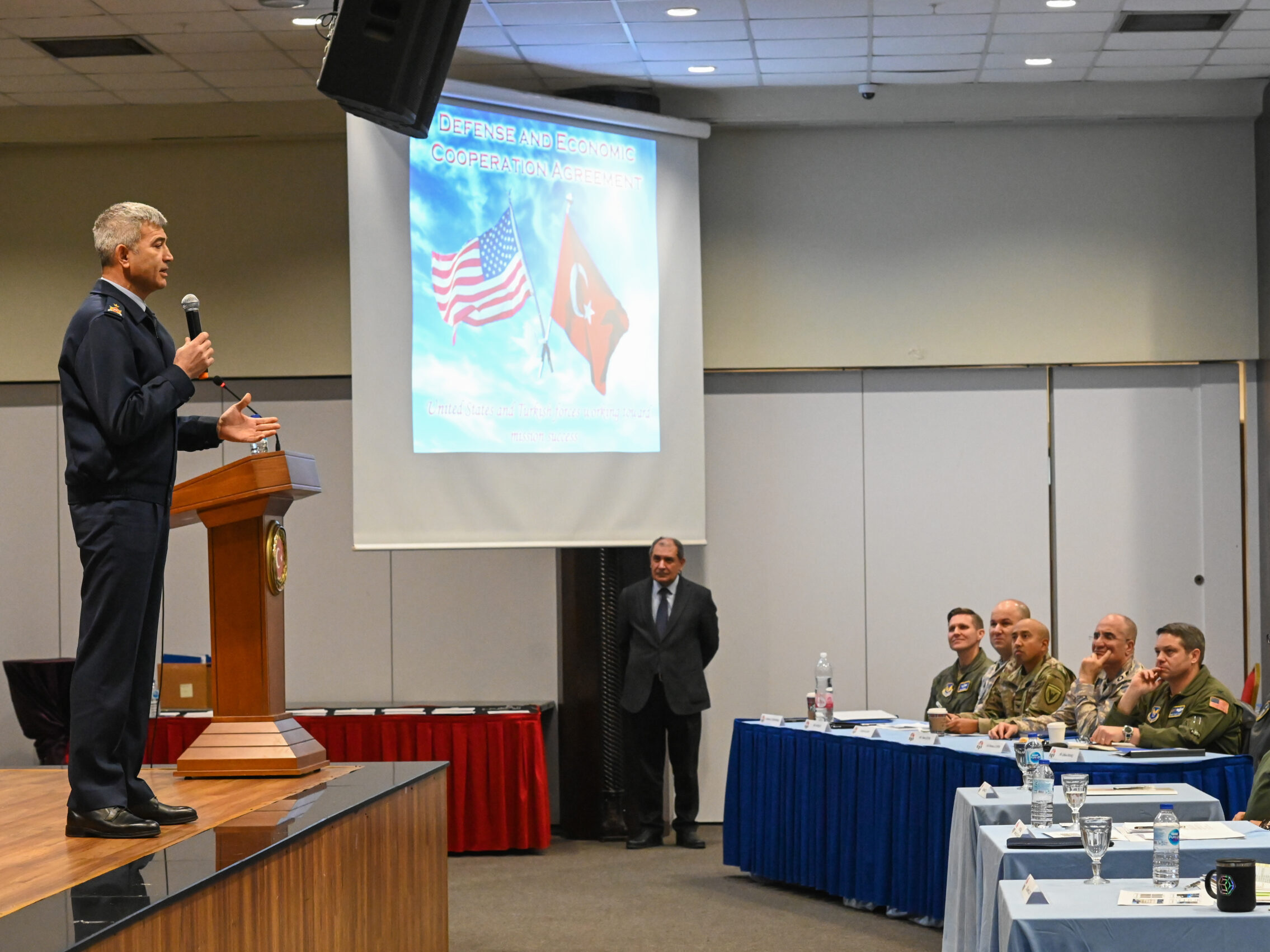
ReportJuly 1, 2026 • 10:00 am ETRich OutzenThe United States and Turkey possess thetwo largestmilitary establishments in NATO and two of the most capable and sophisticateddefense industrial sectorsin the world. The former has the greatest global reach and footprint, while the latter has a unique geography and set of bilateral alliances; this makes each an extremely formidable contributor to overall NATO strength. Washington sets the agenda and tone across Europe and the Middle East, but new dynamics in warfare and geopolitics have increased Ankara’s relative weight. The characteristics of both the United States and Turkey help define the extent of NATO power, and the relationship between the two helps defines its limits. When the national leadership of both countries agree, the possibilities for military, diplomatic, and strategic coordination broaden; when they do not, stasis and tension ensue. Presidents Donald Trump and Recep Tayyip Erdogan have thereforetaken great careto preserve a positive tone and constructive agenda, yet much remains uncertain about the future of US-Turkish relations and what they portend for NATO more broadly. Dynamics have shifted significantly in recent years. Europe haspalpably cooledtoward the United States while, inseveral cases, warming to Turkey. European NATO members pursuing greater defense industrial and operational capabilities have begun to see theTurks in a new light. Gaps in the NATO force modeland industrial output are real, and Turkey is the most viable gap filler. Consequently, we have seen significant new cooperative programs involving Turkey and European partners—especially Spain, Italy, and the United Kingdom (UK). Meanwhile, rivalry between Israel and Turkey is driving a new element in the security architecture of the Middle East:closer strategic collaborationamong Sunni-majority states in the Gulf (Saudi Arabia and Qatar), Egypt, Turkey, and Pakistan. Simultaneously, Israel has pursued greater defense cooperation withGreece, Cyprus,and theUnited Arab Emirates. Instead of a regional paradigm premised on deterrence of Iran and binding of Sunni states to the United States and Israel (the Abraham Accords model), we see a tripolar arrangement in which a new Sunni entente deters Iran (while opposing its collapse) and works to defuse conflicts in Gaza, Lebanon, Syria, and elsewhere—in other words, to constrain Israel’s freedom of military action. It is an odd conjuncture in which two groups of powerful states,both allied with the United States,are moving in opposite directions in the Middle East at the same time thatTurkey becomes more criticalfor the capabilities of both NATO andmajor non-NATO allies. These dynamics call for deft statecraft in Washington and Brussels to manage Israel–Turkey tensions, and they make the upcoming NATO summit fascinating and immensely important. The wars in Iran and Ukraine provide crucial strategic backdrops for the NATO summit. In recent months, expert opinion has started shifting toward the view thatRussia faces a strategic stalematein Ukraine. For Vladimir Putin, monetary and human costs continue to rise without appreciable battlefield gains. It is becoming more likely that Russia will need toaccept compromise terms, realizing that its target has become too formidable and Putin cannot dictate terms. Yet the United States and Israelface their own stalematein the war to end Iran’s nuclear program: having inflicted significant damage to military infrastructure and political leadership, they have not delivered a knockout blow and neither collapse nor capitulation appear on the near horizon. Another example is the 2025 fightingbetween India and Pakistan, which also saw large-scale combat without a decisive result. The dynamics from these wars, coupled with trends in defense technology, suggest that we have entered an era of middle-power survivability as a check on great-power unilateralism. Ukraine survived Russian attack; Iran survived US and Israeli attack. The diffusion of drone technology, artificial intelligence (AI)-driven targeting, satellite imagery and communications, dispersion and hardening techniques, and other tools of current warfare have mademid-sized powers more formidableadversaries. Each case has involved conceptual components—for example,Iran’s mosaic strategyof avoiding symmetric military conflict, absorbing and surviving conventional attack, and maintaining proxy, drone, and missile attacks. Technology has been a factor, as have enduring “rules of the game” pertaining tosuccessful coercive diplomacyor limited wars. The rules include the continuing need for allies and coalitions, the importance of regional framing, and the careful assessment of deployed force against the motive and values of the defender; these generally mean that facile coercion is an illusion. Defenders have absorbed enormous punishment but diplomatic and economic factors have enabled successful resistance. The great-power campaigns might be considered successful punitive campaigns, albeit at high cost, but—at least as of mid-2026—they cannot be consideredsuccessful wars or coercive episodes. The main implication of this development is that anti-Western powers—Iran and Russia—have neither won nor lost the current wars, and they have motive to sustain confrontation and further develop military capacities. Iran might continue to lead a bloodied but intact resistance front in the Middle East. Russia might settle into a frozen conflict with occasional flareups in the Donbas (similar to the 2014–2022 status quo). NATO will need to plan for sustained threats against members or partners from both directions. Further, the deterrent value of overwhelming US military advantagemight have been eroded—both by the failure to get a desired outcome in Iran and from very clear signals of US reticence to do the heavy lifting on European security. There are solid reasons why both European NATO and Sunni states in the Middle East and South Asia increasingly see Turkey as an important partner in deterring and surviving conflict. These trends accentuating Turkish strategic weight make it difficult to understand why a certain circle of political commentators tends to paint Turkey as the“next Iran”and to recommend that NATO expel Turkey from membership. Israeli politiciansand a small but persistent set ofWashington-based commentatorshave argued that a combination of Turkish behaviors has rendered it an unacceptable ally. The cited factors include Turkish criticism and inflammatory statements about Israel, authoritarian steps in the domestic political domain, and assertion of territorial water claims that conflict with those of Greece. Polemicists who have routinely peddled “Turkey is no ally” narratives have become a sort of background noise in Washington that prompts proverbial eye rolling among more serious public policy practitioners and analysts, but the narrative occasionally bleeds into statements fromUS politiciansandacademics. Execration of Ankara does not resonate much outside of Washington, but it contributes to a penumbra of suspicion and animosity that makes closer bilateral defense initiatives (such as sales, co-production, basing, and exercises) a harder sell to Congress. NATO has a very different view of the Turks—as a partner, not a threat. This is echoed in the views of senior NATO officials such as Secretary-GeneralMark Rutteand Supreme Allied CommanderAlexus Grynkewich. It is amplified by the increasing defense trade and closer bilateral collaborations between Turkey andEuropean partners. It has been strengthened both by recent NATOair defense deploymentsin support of Turkey and by Turkish deployments in support of NATO forSteadfast Dart 26and other exercises. Turkey is a countrylargely, if imperfectly, alignedwith Western security interests in both Europe and the Middle East—and one making increasingly important contributions in both areas. In an era of constrained super powers, Turkey has become anindispensable middle power. Consider the facts. It produces and exportsNATO standard equipment. Turkish arms go to NATO, US allies, and nonaligned countries,but not to anti-Westernpowers (Iran, Russia, China, North Korea, Venezuela, etc. ). Ankaraaided Ukrainebefore the West was willing to do so, andhelped pushRussia and Iran out of Syria. Turkishintervention endedthe Russian-backed attempt to overthrow Libya’s United Nations (UN)-recognized government—and Ankara is nowseeking Libyan unification. Ankara has supported Trump’senergy and peace diplomacyacross multiple conflict zones. Turkey is engaged in strategically strengtheningAfrica,South Asia, andCentral Asiain regions where the main competitors are China, Russia, and Iran. Turkey has pursued broad reconciliationwith US Middle East alliesover the past six years. There are thorny areas of divergence and contention between Turkey and a subset of Western countries,especially Israel(over Gaza, Syria, and the regional order) andGreece(over maritime demarcation). That said, there is no realistic scenario for Turkish war with Greece or Israel—certainly not one initiated by Ankara. While Turkey’s numerous critics in Washington would like to portray Ankara as anti-Western, extremist, or isolated because of these regional frictions, nothing could be further from the truth. Europe and the Sunni states are deepening ties—as are many African and Asian states—and Turkey has the world’sthird-largest diplomatic network. What then is the goal of incessant and unrestrained anti-Turkey commentary in Washington? NATO expulsion, international isolation, or war are not on the table. But raising the perceived political cost of cooperating with Turkey so that Congress or the executive branch won’t want to be seen as too close to Ankara is feasible. When US–Turkish relations are constrained by a general atmosphere of suspicion, those competing for regional influence with Ankara stand to gain. Chilling relations with Turkey at a time when Europe, Africa, and many countries across the Middle East and Eurasia are embracing it does not serve the US national interest. Washington does best when it maintains strong alliances, cultivates strong partners, manages intra-Alliance frictions, and guards against truly revisionist actors rather than difficult partners. The NATO approach—and the Trump approach—of harnessing Turkish capabilities and desires to play a more active role in these areas is better policy, and the strange narratives of punishing or isolating Turkey should be seen as the transparent, self-interested, and potentially costly blunders they are. Healthy US–Turkish relations can help secure US interests and allies in the Middle East and Europe, and the 2026 NATO summit should be a showcase for them. Rich Outzen is a geopolitical consultant and nonresident senior fellow at the Atlantic Council in Turkey with thirty-two years of government service both in uniform and as a civilian. Follow him on X @RichOutzen. Explore other issuesExplore the programWithin the Atlantic Council’s longstanding commitment to strengthening the transatlantic relationship, theAtlantic Council Turkey Programconducts research, provides thought leadership, and offers a platform for strategic dialogue between the US, Turkey, and NATO allies to address the region’s toughest challenges and explore opportunities, including in the fields of energy, business & trade, technology, defense, and security. Image: Incirlik AB hosts annual DECA Inspection. Photo by Senior Airman Renan Arrendando. Photo courtesy of Incirlik Air Base.