Watch Webinar - Iran's Two Fronts: Growing Links Between the Middle East and Ukraine Wars - JINSA
As Israel ramps up its operations against Hamas in Gaza City and urges civilians to evacuate combat zones, the terror group has called for Gazans to remain in the area even as its leaders flee Israeli strikes. Palestinian sources have also claimed that Hamas has moved the remaining living hostages above ground, using them as human shields. Israel’s campaign in Gaza City comes amid severe backlash for Israel’s targeting of senior Hamas leaders in Qatar. Israeli Prime Minister Benjamin Netanyahu defended the attack on Qatari soil, asserting to U. S. Secretary of State Marco Rubio during his visit to Israel this week that the strikes were “legitimate. ” While Rubio works towards diplomatic resolve in the Middle East, the United Nations General Assembly gathered in New York, voting overwhelmingly in favor of recognizing a Palestinian state, a move the United States labeled “a gift to Hamas. ” To discuss Israel’s operations in Gaza and its efforts to strike Hamas abroad, JINSA hosted a conversation featuring JINSA Distinguished Fellow IDF MG (ret. ) Yaakov Amidror and JINSA Julian & Jenny Josephson Senior Vice President for Israeli Affairs IDF MG (ret. ) Yaacov Ayish. JINSA President & CEO Michael Makovsky, PhD, moderated the discussion.
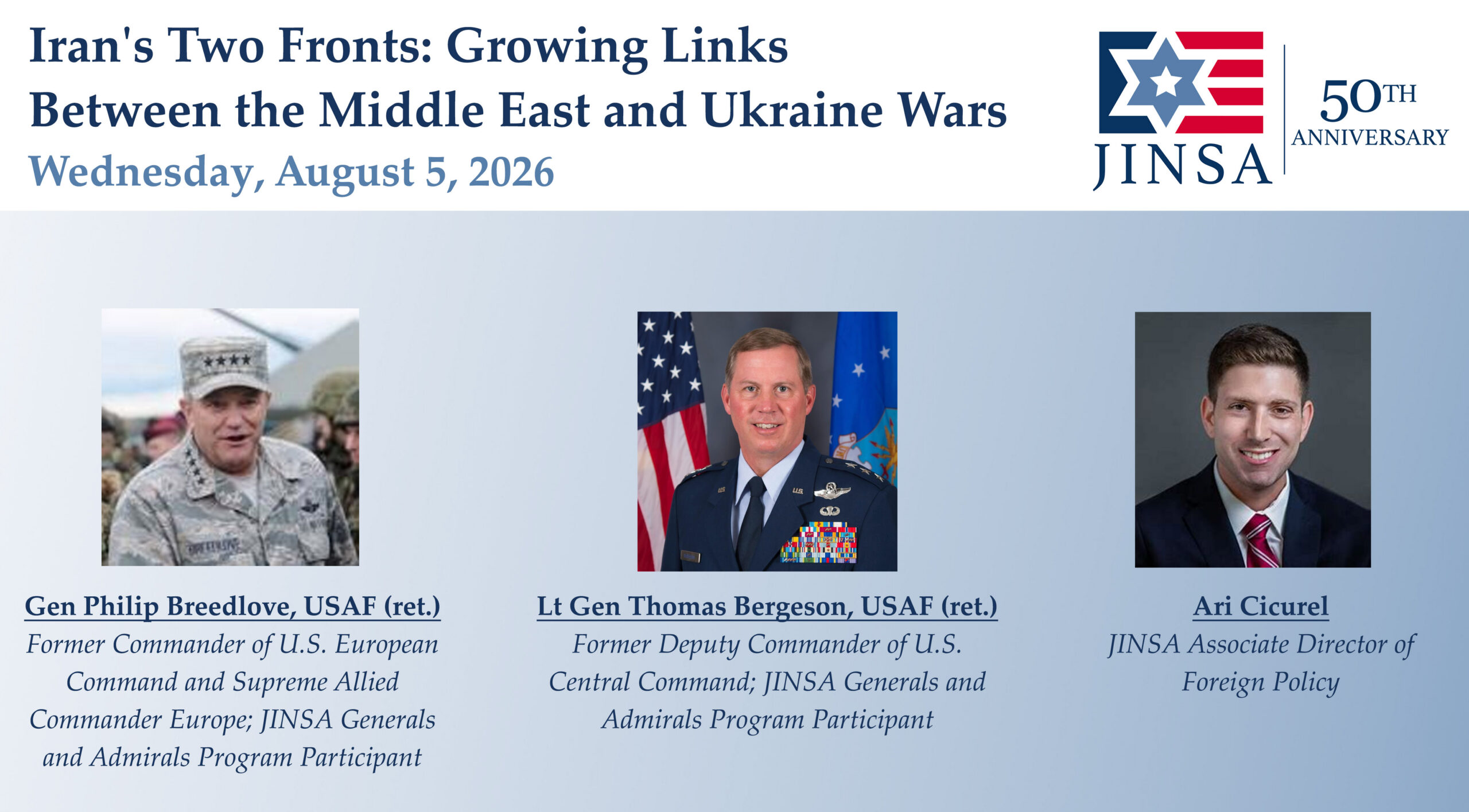
- Wednesday, August 5, 2026|Share:Click here to read transcript. The wars in Ukraine and the Middle East are converging. Iran has supplied Russia with drone technology battering Ukrainian cities while threatening U. S. forces and partners across the Middle East—and the connection runs deeper: Russia has provided Iran with satellite imagery and targeting intelligence, including the locations of U. S. warships and aircraft, enabling more precise Iranian strikes against American forces in the region. Ukraine has begun striking back, hitting Iranian and Russian cargo vessels in the Caspian Sea on July 25 to disrupt Iran-Russia supply lines. Days later, both Ukrainian President Volodymyr Zelensky and Israeli Prime Minister Benjamin Netanyahu were in Washington for separate meetings with President Donald Trump—and the two spoke in person with one another for the first time in three years. Separately, Ukraine has emerged as the world’s leading laboratory for drone warfare and countermeasures—experience increasingly relevant to Israel, which has struggled to adapt to the fiber-optic drone threat now deployed by Hezbollah in Lebanon that was first pioneered on the Ukrainian battlefield. The convergence raises urgent questions for U. S. strategy: how should Washington coordinate across two theaters increasingly shaped by the same adversary network? Can Ukraine and Israel translate their shared interest in countering Iran into meaningful coordination? And what does effective deterrence look like when the Iranian threat spans both fronts simultaneously?To discuss the growing links between the Middle East and Ukraine wars and the implications for U. S. policy, JINSA hosted an exclusive webinar featuring JINSA Generals & Admirals Program ParticipantsGen Philip Breedlove, USAF (ret. ), former Commander, U. S. European Command, andLt Gen Thomas Bergeson, USAF (ret. ), former Deputy Commander, U. S. Central Command. JINSA Associate Director of Foreign PolicyAri Cicurelmoderated the webinar. Gen Philip Breedlove, USAF (ret. )Gen Philip Breedlove, USAF (ret. ) is the former Commander of U. S. European Command and Supreme Allied Commander Europe. He participated in JINSA’s Generals and Admirals program in 2018. Click here to read full bioLt Gen Thomas W. Bergeson, USAF (ret. )Lt Gen Thomas W. Bergeson is the former Deputy Commander, U. S. Central Command. He participated in JINSA’s Generals and Admirals program in 2023. Click here to read full bioAri CicurelAri Cicurel has been Associate Director of Foreign Policy at JINSA since January 2025. Click here to read full bio